
The battle of Lone Pine at Gallipoli is deeply etched in the psyche of Australians, New Zealanders and the Turks. It took place between 6 and 10 August 1915 with tragic losses of over 2,000 ANZACs and a further 7,000 Turkish soldiers.
Over the decades the battle became increasingly symbolic and many memorial parks in towns and cities around Australia were planted with a specimen or grove of “Lone Pines”, usually said to have been propagated from the original tree.
But there is an intriguing and little-known puzzle about the true botanical identity of the original Lone Pine. There are, in fact, three species that can claim some connection to the historic battlefield. You can read more in the Wikipedia story.
https://en.wikipedia.org/wiki/Lone_Pine_(tree)
The original Lone Pine tree was a Turkish Pine (Pinus brutia) which stood on a prominent ridge and was a reference point for soldiers on both sides until it was destroyed by gunfire.
Turkish Pine is native to the Gallipoli Peninsula and scattered specimens grew across the hills of the battlefield and all the trees, except the famous one, were cut down by the Turks for construction of their defensive trenches.
Sergeant Thomas Keith McDowell collected a cone from this tree and put it in his knapsack, where it remained until he returned to Victoria after the war.
About 10 years later, four seedlings were successfully raised by Emma Gray of Grassmere near Warrnambool using the remaining seeds from the cone that Keith brought back.
The seedlings were planted at Wattle Park in Melbourne (8 May 1933), the Shrine of Remembrance (11 June 1933), the Soldiers Memorial Hall at “The Sisters” near Terang (18 June 1933) and the Warrnambool Botanic Gardens (23 January 1934). Only the pines at Warrnambool and Wattle Park now survive.
In 1964, the President of Warrnambool Branch of Legacy Australia, Tom Griffiths, proposed at its Perth Conference to raise and distribute seedlings of the Lone Pine in time to mark 50 years since the Gallipoli landings.
The project was strongly supported by delegates and some cones of Pinus brutia were collected from trees at “The Sisters” and the Warrnambool Gardens and sent to Ben Benallack at the Forests Commission in Melbourne. But the species is notoriously difficult to grow, and the seeds failed to germinate.
The Melbourne Branch of Legacy collected more cones from the Lone Pine tree near the Shrine of Remembrance and, this time, about 150 seedlings were successfully raised at the Forests Commission’s nursery at Macedon under the direction of Dr Ron Grose, Director of Silviculture.
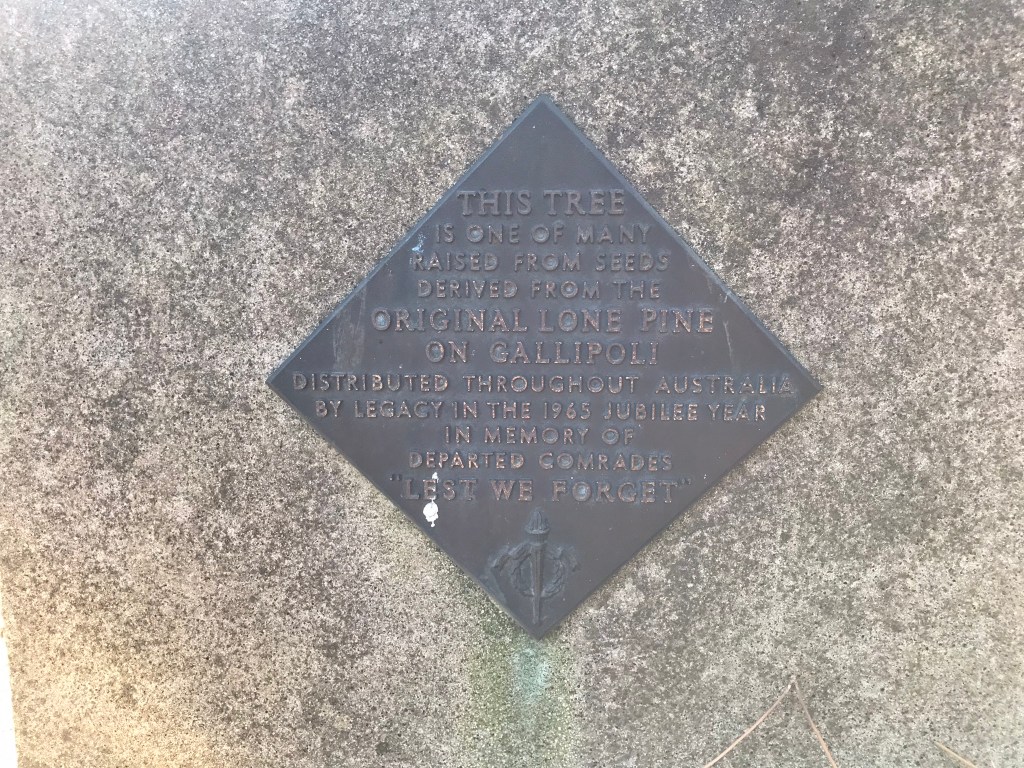
One of these original seedlings was planted at the Victorian School of Forestry at Creswick in 1965. The tree was later dedicated with a plaque by the RSL in 1975.
Disappointingly, the top was busted in 1976 by some over overly exuberant students on their way home from the Farmers Arms Hotel late one night.
The spindly tree is still alive but has struggled to thrive in the overcrowded arboretum. It can be found near the pathway leading up the hill from the Alexander Peacock Gates to the main school building.
https://victoriancollections.net.au/items/5da6e1e621ea671ff8250fd8


 Victoria’s Forests & Bushfire Heritage