
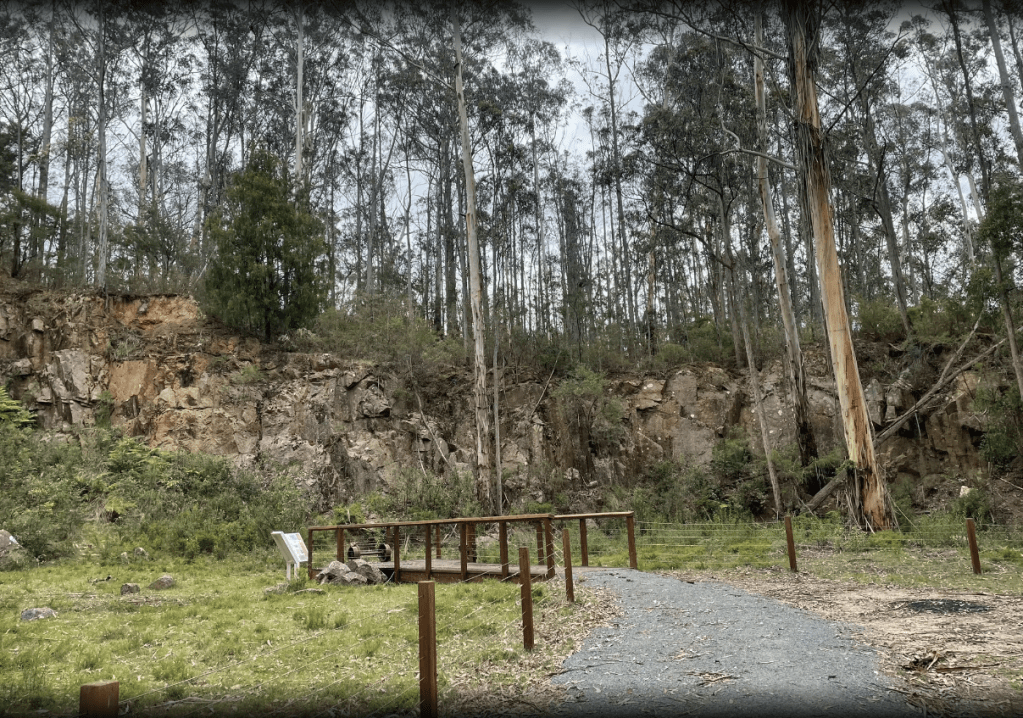
A large granite outcrop at the headwaters of the Mississippi Creek in the Colquhoun State forest, just west of Lakes Entrance, was identified in the early 1890s.
It’s said to be of the same geological formation as the pink granite at Wilsons Promontory, Gabo Island and northern Tasmania.
The beautiful granite will take a high polish and can be used for pillars, casements, sills, steps, or any work that needed a durable and ornamental stone.
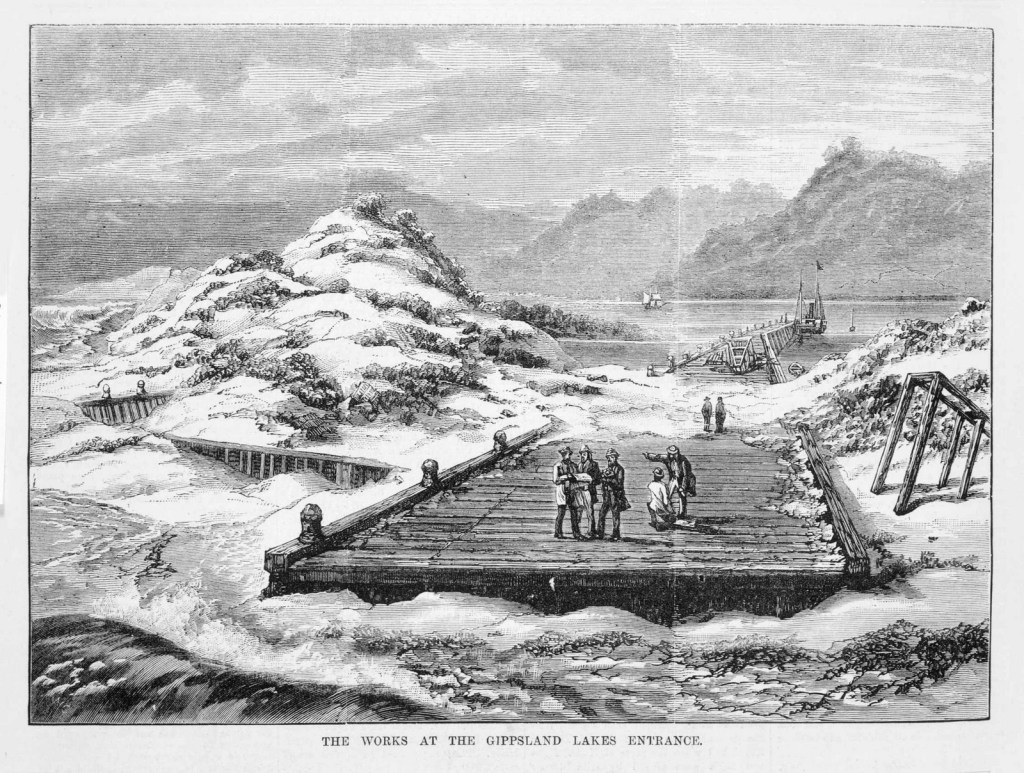
In the years following the goldrush, ships entering the Gippsland Lakes from the southern ocean were subject to the vagaries of shifting sands, floods, winds and tides.
Works began in the 1870s to create an artificial entry and navigable access to the inland lakes system. Two rows of wooden piers were installed on each side of the new entrance and stabilised with stone dropped in between the rows of timber.
But over time, the stone sank into the sand or was displaced by currents and had to be replaced. Teredo worms (termites of the sea) ate what was left of the timbers. Something more permanent was needed for the busy port.
In 1890, a surveyor was sent to take depth soundings of the north arm of the lake and survey the line for a new tramway through the bush to the site of the intended quarries.
Despite the early expectations for the granite in the Mississippi Creek, the stone for reinforcing the piers was brought by ship from Refuge Cove at Wilsons Promontory, and later by bullock dray from a quarry at Wy Yung near Bairnsdale, until at least 1900.
The development of the Mississippi Creek Quarry seems to have begun in early 1904 by local contractors, the Coate Brothers.
Cutting the hard rock used the “hammer and tap” method. Two men took turns with sledgehammers to hit a steel drill held by a third man slowly rotating the drill bit so its didn’t get stuck in the rock. Once the drill was about 2 feet deep into the rock another hole would be started nearby. The holes were then packed with explosives and detonated to crack large blocks of granite from the working face of the quarry. If necessary, the blocks would be drilled and blasted again until they were of a workable size and could be trimmed to shape.
Coate Bros built a 3’6″ gauge steel tramway 13 km through State Forest in 1910 to transport the large blocks of granite, which could weigh as much as 5 tons, to the head of the North Arm near Corner Landing. Rock was then loaded by crane and transported by barge a further 6km to the entrance of the Gippsland Lakes where they had the contract to convert the eastern pier from timber to stone and concrete.
At least one load of 60 tons went on the downhill run per day to the barge landing, but occasionally trucks would derail, and the rock tipped into the bush where they still lay.
Later, some stone was used in Melbourne buildings, the most notable being in 1926 with the Masonic Club in Flinders Street. This use extended the life of the quarry when the civil works at the entrance were complete.
Records indicate that the quarry last operated in 1946 for cartage of some more stone to the eastern wharf at Lakes Entrance. The steel tramway was then salvaged, and the quarry abandoned which became slowly overgrown with scrub and blackberries.
In July 2000, the Federal Government was making money available under the Regional Forest Agreement (RFA) process with “structural adjustment” packages to offset the reduction in sawlogs and corresponding loss of jobs. The Feds were looking for “shovel ready” community projects in East Gippsland.
I’m a keen bike rider and a trail from the Mississippi Quarry to Lakes Entrance had been an idea for a while. I was also the Regional Forest Manager for Gippsland at the time but couldn’t secure funding from the Department.
It all came about in a short phone call, very late one Friday afternoon, when a colleague from Melbourne, Richard Wadsworth, rang looking for projects and about $1M fell into my lap. That’s the way funding bids worked sometimes. I followed up with some paperwork and a formal application the following week, but it was as easy as that…
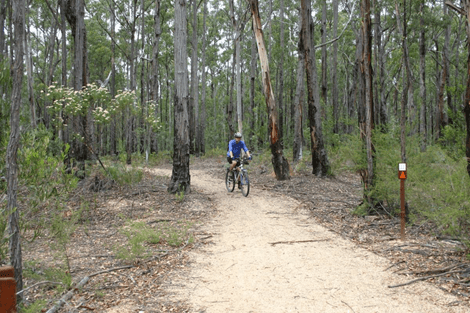
Some of the cash went on the existing rail trail, while Andrew Sharpe and Rob Stewart from Bairnsdale planned and delivered a new project which included a 5km link up a steep hill to the East Gippsland Rail Trail at the junction with Seaton Track.
Most of the old wooden bridges on the tramway had collapsed and needed to be replaced. Remnants of steel rail line and lumps of stone can be found along the track. New signs and a viewing platform at the quarry were built while some old tramway wheels were salvaged for display and a piece of polished granite is included in the design.
It was initially hoped to reinstate the entire tramline from the quarry to the edge of the water and the barge landing site. But some of the old route was private land, so the Gippsland Lakes Discovery Trail, as it became known, ran 7 km downhill from the quarry site to the Log Crossing picnic area before diverting on Shire roads a further 13 km to Lakes Entrance.
The project was complex and not finished until 2003.
The trail along Mississippi Creek now links to a network of new mountain bike tracks through the bush.
https://en.wikipedia.org/wiki/Gippsland_Lakes_Discovery_Trail




 Victoria’s Forests & Bushfire Heritage