The Forest Fire Danger Index (FFDI) was originally invented by the legendary pioneer of Australian bushfire science, Alan Grant McArthur, during the 1950s and ‘60s.
After studying forest science at the University of Sydney in 1945, and later the Australian Forestry School in Canberra, Alan McArthur worked first in softwood plantations in the Tumut and Orange districts.
In 1951, he was appointed the first full-time fire control officer of the Snowy Mountains and began a lifelong quest to understand the behaviour and control of forest and grassland fires.
Then in 1953, Alan transferred to the Commonwealth Forestry and Timber Bureau in Canberra as a fire researcher. Five years later he was appointed Principal Research Officer in the newly created Division of Forest Research within the Commonwealth Scientific and Industrial Research Organization (CSIRO).
Alan was a very hands-on forester and fire researcher. To gather data, he deliberately lit over 450 experimental fires between 1956 and 1961 under a range of low to moderate weather conditions in the Kowen Forest and Bulls Head Creek area around Canberra. There were other test fires near Traralgon and the Wombat Forest near Daylesford.
For obvious reasons, he wasn’t able to light test fires under extreme weather conditions, so his subsequent fire danger equations needed to be extrapolated.
Much of his raw field data was collected by students from the Australian Forestry School and later the Australian National University where he lectured. Alan used his fit and hardy crew, armed with time stamped rocks, to mark the progress of the test fires and collect the data as well as map fire progression for his meter, a hugely useful improvement in fire prediction at the time.
Alan made thousands of detailed observations of things like wind speed, RH, temperature, cloud cover, rainfall, fuel moisture content, flame height, fire intensity, spotting distance, rate of spread, fuel quantity. He also made subjective assessments of fire suppression difficulty.
Alan published his landmark paper, “Controlled burning in eucalypt forests” in 1962. Leaflet No. 80, as it was known, proved a turning point for forest and fire managers across Australia.
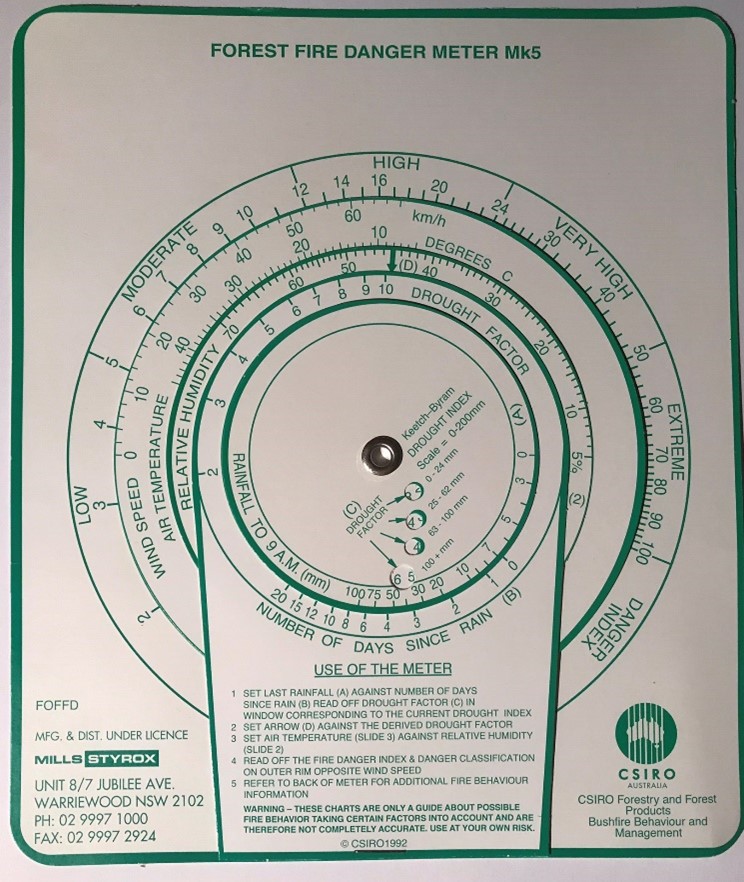
More importantly, Alan was very practical forester and wanted his work to be useful to people in the field, so after several iterations he came up with the now familiar circular slide rule called the Forest Fire Danger Meter (FFDM). The Mk 4 version first appeared in operational use in 1967.
There is also a grasslands fire danger meter.
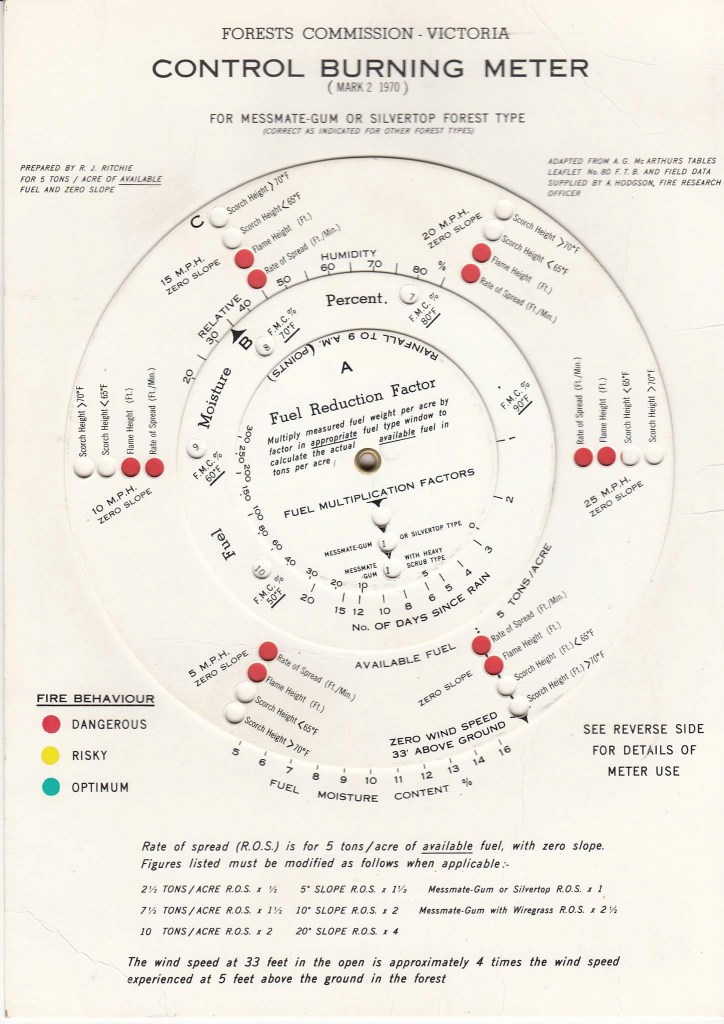
Two Forests Commission staff, Athol Hodgson and Rus Ritchie, built on McArthur’s pioneering work and by applying their own practical experience, developed a modified version in the late 1960s called the Control Burning Meter which was better suited to Victorian forest conditions.
Alan’s research work, in combination with new aerial ignition techniques developed in Western Australia and Victoria, led directly to a rapid escalation of the area of fuel reduction burning, which peaked in Victorian forests 1981 at 477,000 ha.
The FFDI meter uses measurements of dryness, based on rainfall and evaporation together with the Keetch-Bryram Drought Index to calculate a Drought Factor (DF) ranging from 1 to 10.
The Drought Factor is then combined with wind speed, temperature and relative humidity to calculate a FFDI in a range of 0 to 100.
By assessing fuel load (tonnes/ha) and slope, the fire behaviour characteristics such as Rate of Spread (ROS), flame heights and spotting distance can be estimated under a range of fire danger indices.
Most successful firefighting, and indeed fuel reduction burning, occurs when the FFDI is in the “Moderate” range between 5-12. The FFDI rises to “High” between 12-24 and “Very High” between 24 and 50. A day with an index exceeding 50 is considered “Extreme”. (see note below).
Alan used the conditions of the 1939 Black Friday fires as his example to set the upper limits of FFDI at 100.
However, the FFDI went “off the scale” on both Ash Wednesday in 1983 and Black Saturday in 2009. Under these extreme or catastrophic bushfire conditions, the weather rather than fuel load or arrangement, becomes the dominant factor influencing fire behaviour.
But for anyone who has been involved in bushfires they will know that the FFDI has its shortcomings.
- The original system was only designed for use in forests and grasslands. But Australia has lots of different types of vegetation such as Mallee heath, woodlands and open savanna, and the FFDI system does not forecast those well.
- The FFDI meter does not consider all the conditions which have an impact upon fire behaviour such as wind changes and atmospheric stability.
- The model begins to break down at the extreme end of the scale and small changes to temperature, humidity and wind speed can have a huge influence on the fire danger index.
But no matter what the shortcomings of the FFDI meter, Alan’s scientific legacy is unquestionably huge and has served forest firefighters very well over the decades. New research will refine and develop even better models.
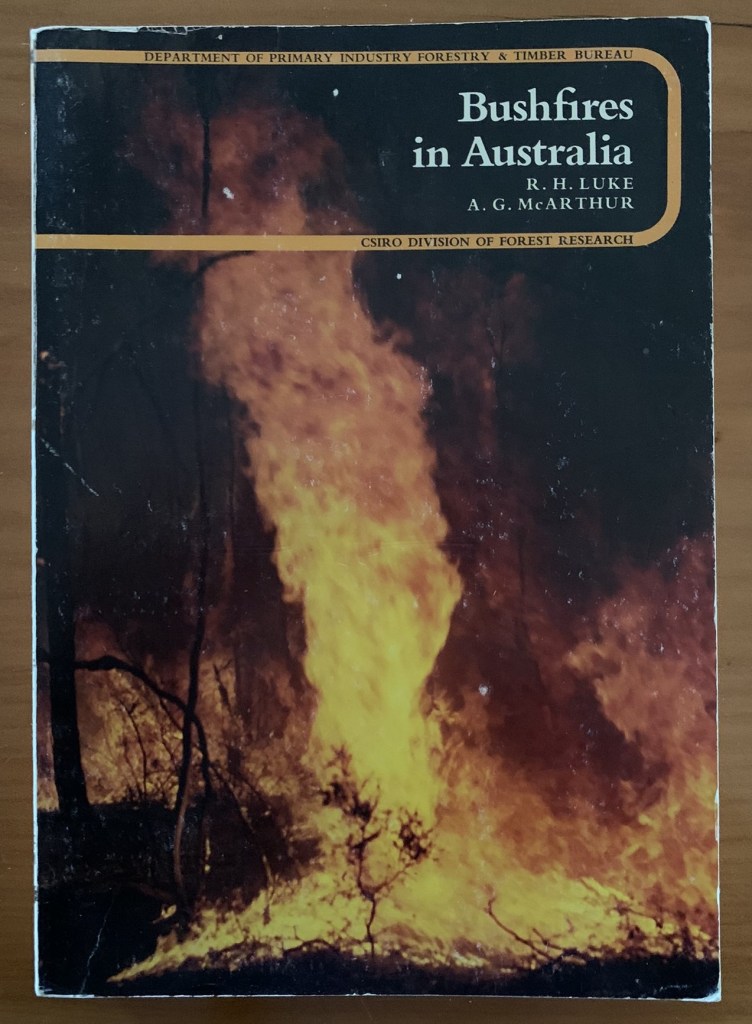
Alan’s seminal book “Bushfires in Australia” was published in 1978 with another forester Robert Henry (Harry) Luke and remains compulsory reading for every bush firefighter. Alan retired from the CSIRO in 1978 and died later that year.
Note: Each State once had their own fire danger ratings, but a new and consistent system was introduced across Australia in 2022.
No Rating (< 12), Moderate – plan and prepare (12-23), High – ready to act (24-49), Extreme – take action now (50-99), Catastrophic – leave early (>= 100).
https://adb.anu.edu.au/biography/mcarthur-alan-grant-10889
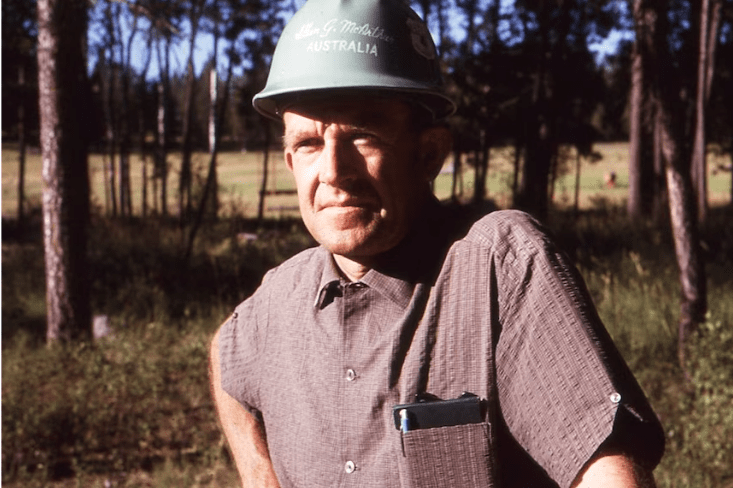


The McArthur Forest Fire Danger Meter (FFDM) first appeared in operational use in 1967 as the Mk 4. Photo: Jack Gillespie.

https://www.tandfonline.com/doi/full/10.1080/00049158.2020.1739883
 Victoria’s Forests & Bushfire Heritage