
When travelling around State forests it’s not uncommon to find a lonely and forgotten grave tucked away in the bush. The last resting place of some unlucky traveller or pioneer killed in an accident, unable perhaps to receive medical aid in time. They were usually buried where they died.
The grave of former dance girl and colourful pub owner, Kitty Kane, which is just north of Walhalla on the Aberfeldy Road, is probably one of the better known in Gippsland.
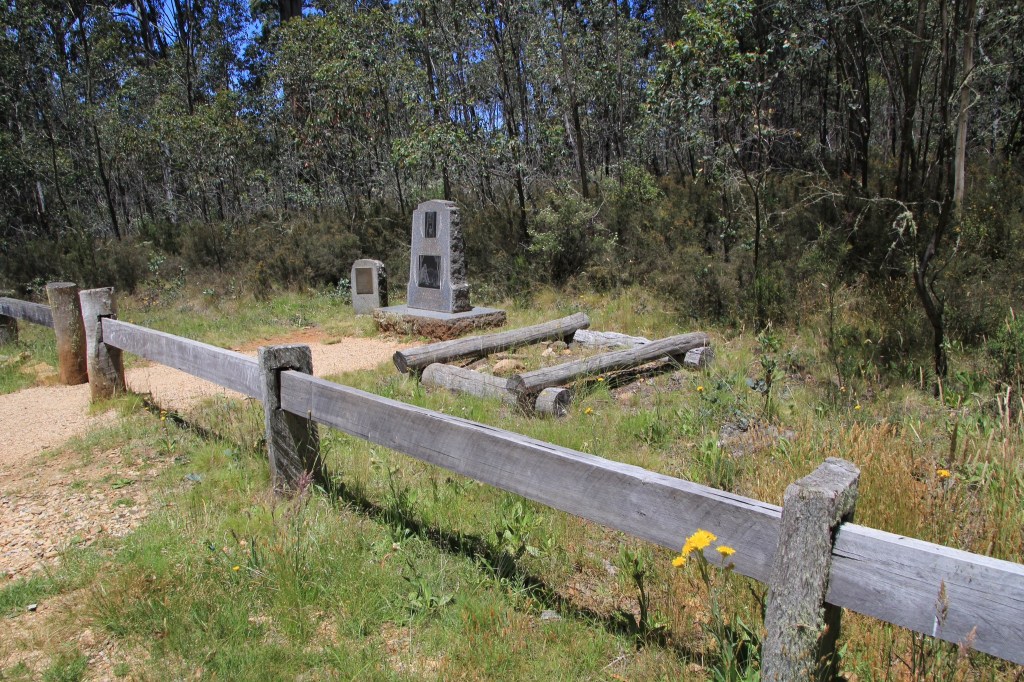
About 30 years ago, I was inspecting logging coupes and new road works at Dargo with the Forests Commission overseer, Brian Madigan, and he took me to the remote and rather unusual Dog’s Grave, about 45 km southwest of Omeo on the Birregun Road.
Cobungra Station has a tradition dating back to March 1851 when George Gray, of Wangaratta, sent his two sons and four stockmen with a herd of some 600 beef cattle in search of pasture following the bushfires of Black Thursday, 13 February 1851.
The Gray family had grazing interests extending over the Great Dividing Range to the headwaters of the Wentworth River. They employed a drover, Peter Meehan, (sometimes spelled Meighan) to look after their cattle on the south side.
In his lonely vigil Peter got to know every creek and gully from Mt Birregun to Mt Baldhead while seldom meeting anyone. His only companions were Skinny, his horse and Boney, his dog.
As with all good bush folklore, there are a couple of versions of the story, but the commonly accepted one goes that in 1863, Boney, most likely an Australian Kelpie, died after it ate a poisoned dingo bait.
At the time, Peter was said to be driving cattle from Cobungra Station towards Dargo. On occasion the stockmen took stock as far south as the Stratford or Maffra sale yards.
Normally, Mount Birregun was covered in snow during winter which made it necessary for the drive to start in the autumn. It usually took between seven and eight days for the whole trek, depending on the weather and number of cattle. It was a perilous journey along the steep and narrow bridle paths with the Dargo River below.
Boney died at the first camp site into the drive towards Dargo and Peter built a small grave of flat stones and erected a rough bush picket fence.
Peter drowned in the Dargo River under mysterious circumstances in about 1883 and is buried in the local cemetery.
Years later in 1888, a camp cook with a government survey team examining a possible railway route from Briagolong via Dargo through to the goldfields of Omeo, noticed the dilapidated grave and rebuilt the fence, but bushfires inevitably destroyed it, and the site was lost again.
The stock route became redundant and was abandoned in about 1932 when the Alpine road connecting Cobungra Station to Omeo was completed.
However, the general location of Dog’s Grave remained marked on old Forests Commission inch-to-the-mile mapsheets.
In 1964, local Dargo identity and mountain cattleman, Jack Treasure, along with John Neilson, the Department of Mines Geologist, set out to find the exact location of the lost grave. They were acting on additional information from elderly Dargo resident David Phelan.
It took a while, but they eventually found a clearing near a creek and a pile of rocks that had once been the hearth and chimney of an old cattleman’s hut. A bit more searching and Dog’s Grave wasn’t far away. The pair then erected a third wooden fence.
A decade later in May 1975, two magnificent Harcourt granite headstones, made by Melbourne stonemason John Giannarelli, were unveiled beside Boney’s original grave.
The main headstone has an image of Boney and, below it, another inspired by Frederick McCubbin’s well-known painting “Down on his Luck”. A smaller granite stone on the left has a brass plaque with bush poem written by Jack Treasure in 1964.
The monument is a tribute to all pioneering families of the high country, and, for the first time, to the Australian Kelpie.
The unveiling was performed jointly by the Avon Shire President, Mr Gordon Hughes and Mr Louis Pendergast, President of the Omeo Shire. Dignitaries from the local historical societies, together with groups of cattlemen and their families attended the ceremony. Bob Fulton from the Forests Commission at Swifts Creek provided approval and support to erect the memorial on State forest.
The alternative story from Charles McNamara, a descendant of the family which owned Cobungra, is that the dog was called Angus and owned by drover Johnny Crisp.
The legend surrounding Dog’s Grave will never be fully settled, no matter how many times it gets debated over a beer at the bar of the Dargo Hotel or the Golden Age at Omeo. Either way, it’s worth a visit.



 Victoria’s Forests & Bushfire Heritage