
The Secretary of the Forests Commission Victoria, A V Galbraith issued instructions to Fireguards in about 1920. They included the following…
- Fireguards are responsible for the safety from fire of the whole of the forest area entrusted to their charge and were under the immediate control of the District Forester.
- They needed to provide their own strong, active, riding horse, and keep it in good condition and fit for daily work in the forest, a well as paying all the cost of feeding it properly at their own expense.
- Each day during the fire season they must carry out mounted patrol work, visiting all dangerous places where there is inflammable debris or dangerously dry vegetation, or where, in the neighbourhood of settlement, timber cutters’ operations, or travellers’ camps, there is danger of fire breaking out.
- They must prevent timber cutters, settlers, travellers, tourists, or other persons from lighting any fires whatsoever (except small necessary campfires in the bed of a creek or on the edge of a dam).
- When any outbreak of fire occurred within or near the boundary of the forest they were to proceed at once to put it out, and if found that it is spreading dangerously, or getting beyond control, they must summon such assistance as is absolutely necessary to extinguish it.
- They were supplied with axes, rakes, hide-beaters and water bags which remain the property of the Crown, and which must be properly accounted for by him at the end of the fire season.
- In the event of continued wet or showery weather, when it is clearly safe to do such work, and where they can easily control the fire, they will carefully burn small belts of inflammable debris and undergrowth which are a danger to the forest, but when in doubt as to the safety of burning under such conditions they must not light any fire.
- They will also during such weather, or when it is cool, and clearly safe to do so, employ themselves in cutting firebreaks, and narrow fire-lines on ridges and spurs as far as possible at right angles to the prevailing winds; also through and around belts of valuable young pole-timber with the object of protecting them from fire.
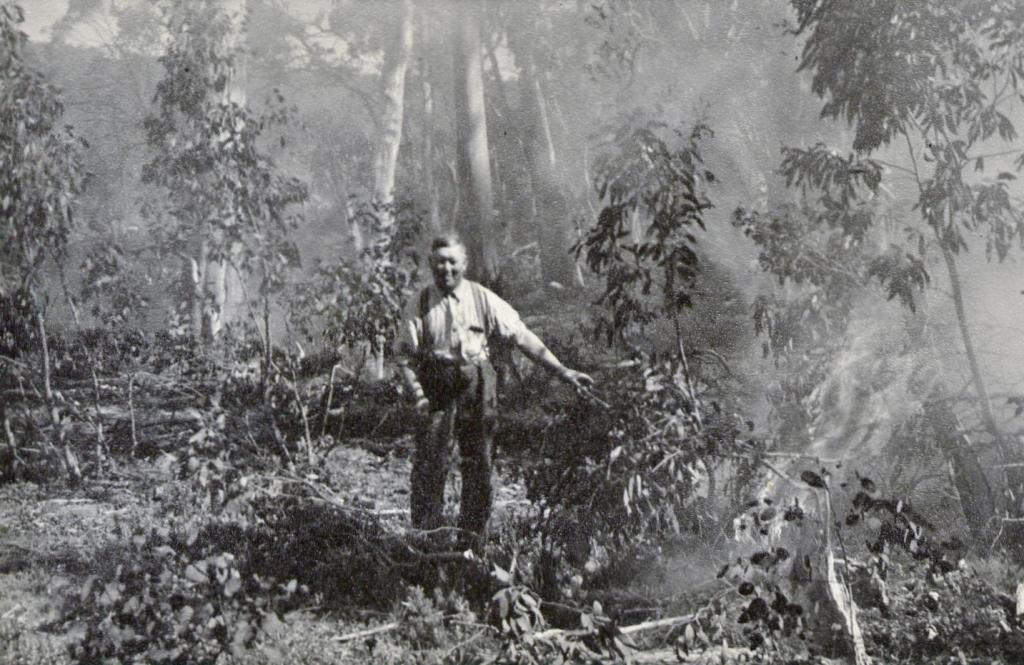
Probably, one of the most famous FCV fireguards was Bill Ah Chow who lived at Moscow Villa and was the fire lookout at Mt Nugong during the summer months.
What a great job…
https://drive.google.com/file/d/1qQro7mkEcQFk2W-xR-qEbONaZ3RAwnmm/view
Photos: At the end of the summer fire spotting season, and after the first good rain of autumn, Bill would set off on his horse along the many bridle paths that criss-crossed the alpine country as far as the NSW border throwing matches along the way to burn forest fuels and reduce the bushfire risk. Source: Ah Chow family.

 Victoria’s Forests & Bushfire Heritage