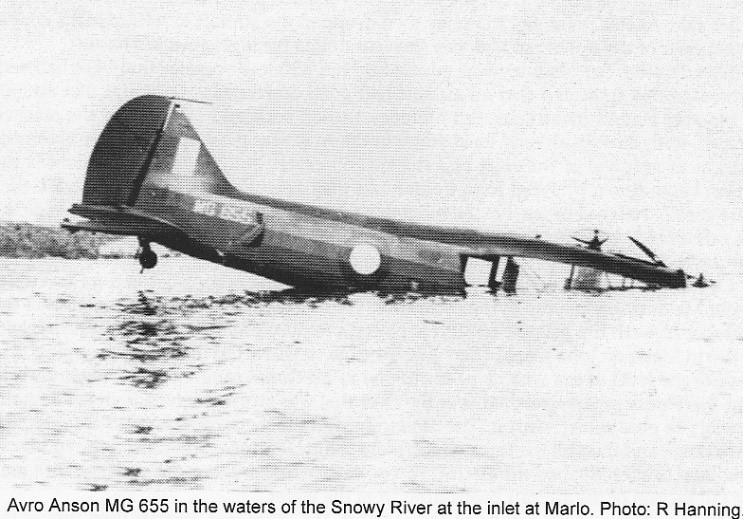
In the summer of 1946, a request was made by the Forests Commission to the RAAF base at Bairnsdale for bushfire reconnaissance flights over the Snowy River area in East Gippsland.
Because of the long-standing relationship with the Air Force, authorisation was often given for FCV staff to act as air observers in the RAAF aircraft.
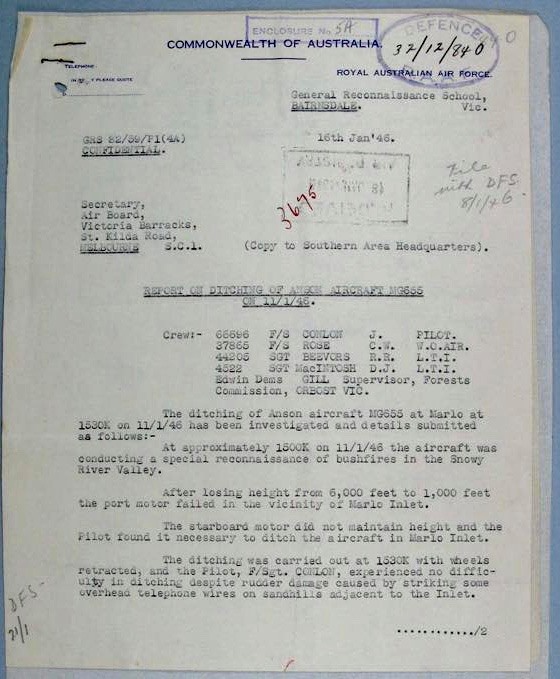
On 11 January 1946, three Avro Anson’s based at Bairnsdale flew missions with Commission observers onboard to check on bushfires. Orbost District Forester, Ted Gill, went along in Anson MG655 piloted by Flight Sergeant John Conlon.
Once over the forest the RAAF pilots took their instructions from the FCV observers.
Each Anson had a flight time of about four hours which enabled coverage of a large area of the remote bush by flying three abreast but widely separated. Radio communications was via the RAAF base at Bairnsdale as well as testing communications with new FCV ground radios. They planned to fly as far as the NSW border and return via Orbost, Nowa Nowa and Bruthen to the base at Bairnsdale with a minimum altitude of 1000 feet.
But on the return trip Anson MG655 collided with some overhead wires at Marlo and crashed into the Snowy River.
Pilot Conlon said under oath at the subsequent RAAF inquest that his Anson was at a height of 6000 feet near Mt Ellery and began a long glide towards the coast with the intention leveling off at 1000 feet before flying home to Bairnsdale.
But late during the descent the port engine failed to respond, and he continued losing height even with the starboard engine on full power. He still had plenty of fuel.
He advised the two other aircraft by radio and his intention of a forced landing on the beach at Marlo. On approach he said the aircraft flaps wouldn’t operate properly to slow his airspeed and he unavoidably hit two telephone wires strung across the inlet and ditched his aircraft into the river where it floated.
Meanwhile, the two other Ansons circled overhead and reported the crash by radio to the RAAF at Bairnsdale and that the occupants were safe before heading back.
There are no records of this crash in FCV Annual Reports or the Snowy River Mail newspaper archives.
But the story was all BS. It can now be revealed that the pilot John Conlon and other the airmen colluded to fabricate their evidence at the RAAF inquiry to cover up the fact that they had been flying too low.
The pilot of one of the Ansons, Sergeant Kevin Moloney, had a reputation for low flying contrary to standing RAAF orders. On the day of the accident Moloney decided to fly within a couple of feet of the water along a straight section of the Snowy River running roughly parallel to the ocean beach. The sheltered section of the inlet near Marlo was a safe anchorage for fishing trawlers and Moloney flew in a simulated strafing attack on the boats by ducking under the telephone wires, then skimming over the sandbanks and just missing the tops of the masts, as he had done many times before.
John Conlon had flown with Moloney before but had not followed his low flying shenanigans but, on this occasion, plucked up the bravado to emulate the mock attack on the trawlers.
But on their high-speed approach, which was a bit further above the water than Moloney had flown, Ted Gill was too late in warning the pilot of the cables strung across the water which then sheared off part of the cockpit and observation dome before tangling in the flaps and rudder as well as hitting the tail fin.
Crunch… the aircraft hit the water nose first and thankfully nobody was injured. Everyone including Ted climbed onto the wings and were taken ashore in boats.
Ted Gill later became Chief Fire Officer of the Forests Commission and needed very little encouragement to tell of his aviation adventure and how he ruined his new shoes wading ashore from the wreckage.
Ref: Tony Clark – 2018. Remember them – tragic RAAF accidents in Gippsland during WW2
 Victoria’s Forests & Bushfire Heritage