
Most people know about the Black Saturday Bushfires in 2009, and possibly can recall Ash Wednesday in 1983, or maybe have even heard of Black Friday in 1939.
But very few could recount the 1943-44 summer bushfires when over 1 million hectares was burnt, 51 people were killed, 700 injured, and 650 buildings were destroyed.
The first major losses of the season were 80 years ago today on 22 December 1943 when 10 members of the Wangaratta bushfire brigade, including two 14-year-old boys, were overwhelmed by fire. This monument is on the Great Alpine Road at Tarrawingee.
The tragedy indirectly led to the formation of the Country Fire Authority (CFA) a year later.
More deadly bushfires in mid-January burnt across the state and even into the outskirts of Melbourne and Geelong. But the loss of a further 13 lives at Yallourn on 14 February 1944, together with the impact on the State’s electricity supplies when the critical brown coal fields caught alight, finally brought the bushfire season into sharp media and political focus.
There was a justifiable public outcry at the lack of government action after similar events five years earlier in 1939 and the landmark Royal Commission by Judge Stretton. One of his key recommendations had been to create a single fire service for country Victoria.
But the war years had intervened and arguably the legislative reforms recommended by Judge Stretton had moved to the back burner.
However, following the summer of 1943-44, the Premier Sir Albert Dunstan and Minister for Forests, Sir Albert Lind, who had both delayed legislative changes in Parliament, decided there was no alternative but to ask Judge Stretton to chair a second Royal Commission.
Stretton’s report returned to his earlier themes and once again highlighted the lack of a cohesive firefighting ability outside the Melbourne area.
After nearly six months of debate and argy-bargy in State Parliament, legislation to establish the Country Fire Authority (CFA) was finally passed in two stages on 22 November and 6 December 1944. The Chairman and Board members were appointed on 19 December 1944. The CFA came into legal effect on 2 April 1945.
The Forests Commission held two seats on the new CFA Board with Herbert Duncan Galbraith (the man behind Stringers Knob fire tower at Orbost) together with Joseph Firth. The Forests Commission Chief Fire Officer, Alf Lawrence, was appointed later in 1946. The CFA then took responsibility for fire suppression on “Country Victoria” leaving the Forests Commission to focus on the public land estate such as State forest and National Parks which amounted for the remaining one third of the State.
https://en.wikipedia.org/wiki/1943%E2%80%9344_Australian_bushfire_season
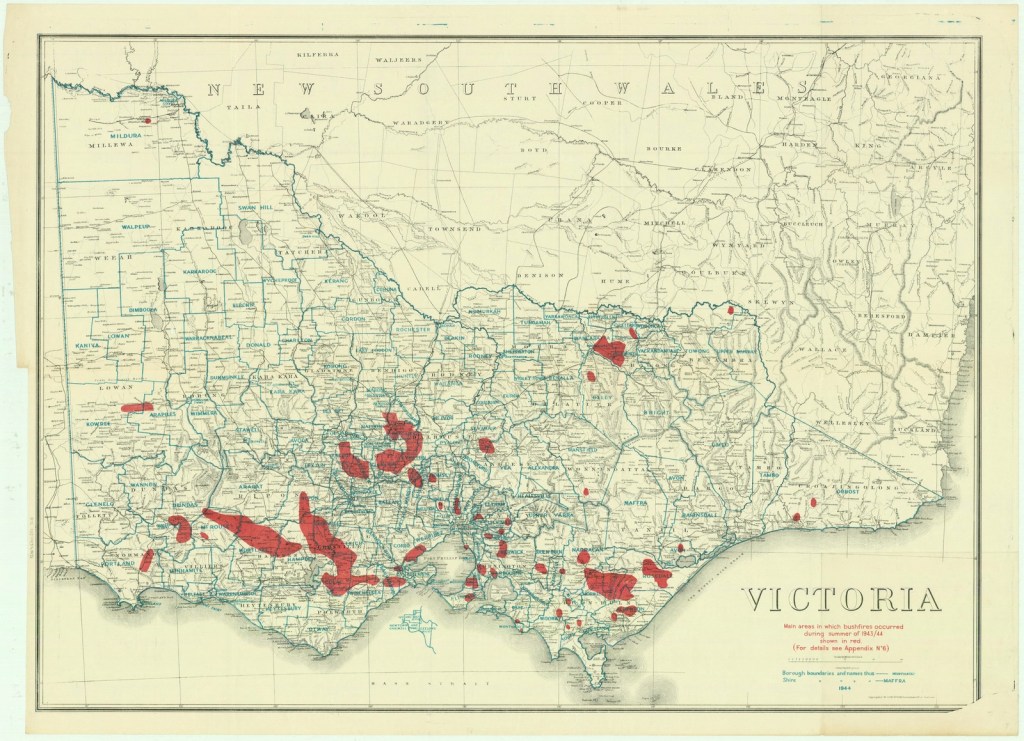
http://handle.slv.vic.gov.au/10381/119987
 Victoria’s Forests & Bushfire Heritage