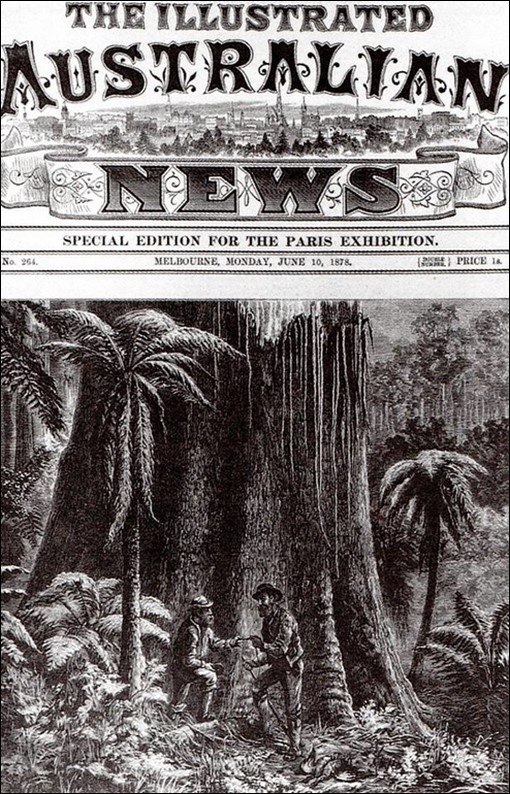
It’s often said that mountain ash, Eucalyptus regnans, is the world’s tallest flowering plant, and possibly the tallest plant of all time, although no living specimens can make that claim.
Tree height is influenced by species, genetics, age, stand density, soil type and depth, rainfall, aspect, altitude, protection from wind and snow damage, fire history and insect attack.
Tree scientists believe that trees have a theoretical maximum height of 430 feet (130 m) even though there are many historical claims of taller trees.
The main physiological factor limiting tree height is its ability to suck a continuous column of water up against the forces of gravity. The crowns of the tallest trees need to lift sap more than 10 times the surrounding atmospheric pressure by combining the complex physics of capillary action and leaf transpiration. Contrary to popular belief, tree roots do not pump water although root pressure is a factor.
As early as 1866 Baron Ferdinand Von Mueller, the Victorian Government botanist, published some astonishing, and probably exaggerated, claims of a mountain ashon the Black Spur near Healesville being 480 feet high.
There were similar reports from nurseryman David Boyle and others of trees in the Yarra Valley, Otways and Dandenong Ranges reaching “half a thousand feet”.
Doyle was later savagely criticised by Melbourne newspapers in 1889 about a tree he had named “The Baron” in homage to his friend von Mueller.
The tree was growing at Sassafras Gully in the Dandenong Ranges and Doyle said he had initially measured it in 1879 at 522 feet tall. It was later remeasured for the Melbourne exhibition in 1888 where it had reduced in size to 466 feet. However, when properly measured by Commissioner Perrin from the Forest Department and surveyor Mr Fuller from the Water Supply Dept in 1889, it was found to be only 219 feet 9 inches – a somewhat catastrophic reduction in height to less than half of that originally claimed. Its girth had also inexplicitly shrunk from 114 feet to 48 feet. Poor measurement techniques in thick scrub probably being the most generous explanation of their dimensional discrepancies.
William Ferguson, the State Government’s first “Overseer of Forests and Crown Land Bailiff” wrote to the Assistant Commissioner of Crown Lands, Clement Hodgkinson in 1872 reporting trees in great number and exceptional size in the Watts River catchment but his account is often disputed as unreliable.
“Some places, where the trees are fewer and at a lower altitude, the timber is much larger in diameter, averaging from 6 to 10 feet and frequently trees to 15 feet in diameter are met with on alluvial flats near the river. These trees average about ten per acre: their size, sometimes, is enormous. Many of the trees that have fallen by decay and by bush fires measure 350 feet in length, with girth in proportion. In one instance I measured with the tape line one huge specimen that lay prostrate across a tributary of the Watts and found it to be 435 feet from the roots to the top of its trunk. At 5 feet from the ground, it measures 18 feet in diameter. At the extreme end where it has broken in its fall, it (the trunk) is 3 feet in diameter. This tree has been much burnt by fire, and I fully believe that before it fell it must have been more than 500 feet high. As it now lies it forms a complete bridge across a narrow ravine” …. William Ferguson, The Melbourne Age, February 1872.
The Victorian public remained fascinated by large trees and to celebrate the Melbourne Centennial Exhibition in 1888 offered a reward for the tallest tree. Parliamentarian and exhibition organiser, James Munro personally offered an additional £100 for anyone who could locate a tree taller than 400 feet. No such tree was ever found but there were issues with the time allotted for the survey.
The tallest tree reliably measured for the 1888 Exhibition was the “New Turkey Tree” near Noojee at 326 feet 1 inch.
In 1976, a monument was unveiled by the Hon Jim Balfour to the “World’s Tallest Tree” near Thorpdale which, in 1884, was measured twice by a surveyor George Cornthwaite at 375 feet, once in the upright position, and again after it had been chopped down. This account was reported in the Victorian Field Naturalist many years later in July 1918 but is often considered the most reliable record of Victoria’s tallest tree.
The Chairman of the Forests Commission, Alfred Vernon Galbraith studied mountain ash for his Diploma of Forestry and wrote in 1937 that “they can make serious claims to be the world’s highest tree”. His successor, Finton Gerraty personally measured a fallen tree near Noojee after the 1939 bushfires at 338 feet and with “its top tantalisingly broken off”.
Recent measurements between 2000 and 2002 of over 200 of Victoria’s trees found the tallest specimen of mountain ash was inside the Wallaby Creek Catchment near Kinglake being over 300 years old and 301 feet (92 m) high. The height was accurately determined using a ground-based laser rangefinder and then verified by a tree climber with a tapeline, however the tree later perished along with 15 other tall trees during the 2009 Black Saturday bushfires.
The tallest regrowth mountain ash in Victoria is currently named “Slinky Sloan in the Upper Yarra at 305 feet (93 m).
Australia’s tallest measured living specimen is named Centurion and stands at 330 feet (100.5 m) in Tasmania. However, I’m aware surveys are underway, and this may have changed.
Whether a mountain ash over 400 feet high ever existed in Victoria is now almost impossible to substantiate but the early accounts from the 1860s are still quoted in contemporary texts such as the Guinness Book of Records and Al Carder as well as being widely restated on the internet.
Currently the world’s tallest living tree is a Coast Redwood, Sequoia sempervirens, named the Hyperion, discovered in California in 2006. It is believed to be between 700 and 800 years old and was measured at 380.3 feet (116 m).
Photo: This mountain ash from Fernshaw featured on the cover of the Illustrated Australian News of June 10th, 1878. Unofficial measurements were 430 feet (131 meters) from base to crown, 380 feet (116 meters) to its first branches with a girth of 80 feet (24 meters). Source https://trove.nla.gov.au/newspaper/article/60095304
 Victoria’s Forests & Bushfire Heritage
One thought on “Tall trees and taller tales.”