
The most common way that Australian foresters measure tree diameter is to place a calibrated tape around the stem at breast height (1.3m). It’s simple, but can be slow, particularly if the scrub is thick, or if there are heaps of trees.
The Biltmore Stick was developed at the famous Biltmore forestry school in North America during the 1890s. It’s also sometimes known as a “Cruising Stick”.
The stick looks a bit like an everyday wooden yardstick with etched markings. They often include a Hypsometer scale to estimate tree height as well.
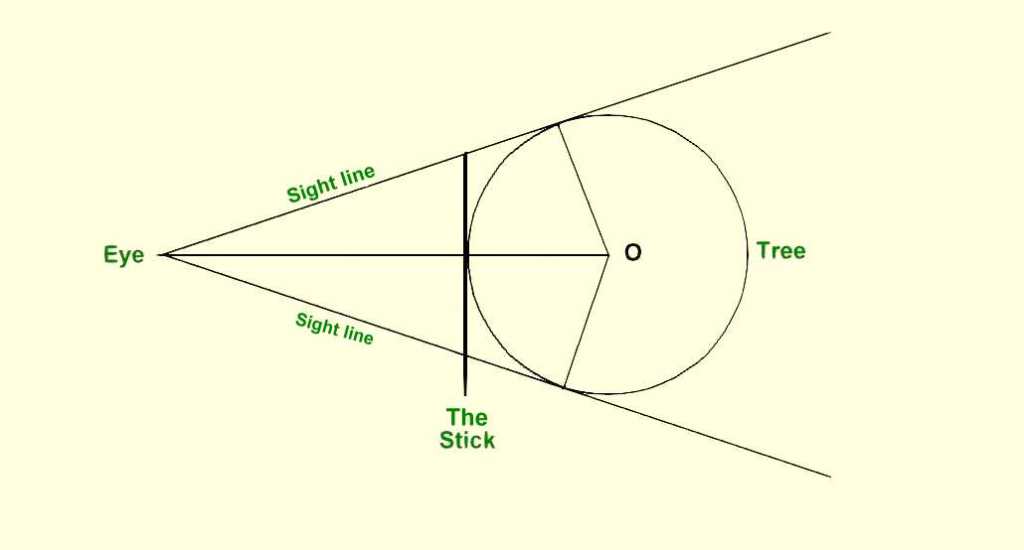
The specially marked Biltmore stick is held horizontally at arm’s length against the tree trunk at breast height. A sighting is then taken along the tangent of the stem to read the diameter directly from the scale.
By using some marvellous mathematics, and the trigonometry of ‘similar triangles”, the Biltmore measuring stick can quickly give a pretty accurate estimate of Diameter Breast Height Over Bark (DBHOB).
For some reason, the Biltmore stick is not commonly used in Australia, but some years ago I was involved in a trial to compare them to the more common diameter tape, and they were found after a bit of practice to be remarkably reliable.
Photo: Using a Biltmore Stick, Jasper County, South Carolina. August 1946: Source: Forest History Society
 Victoria’s Forests & Bushfire Heritage