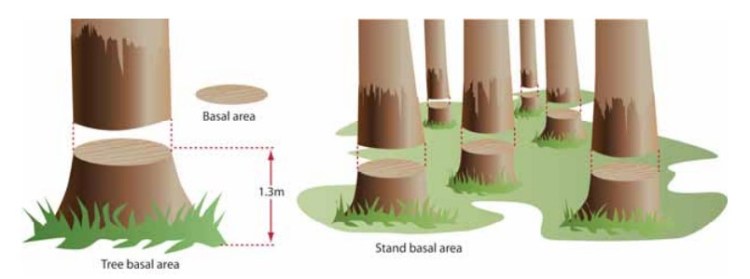
Foresters usually measure the diameter of trees at Breast Height – traditionally 4 foot, 6 inches – now 1.3 m – which is termed Diameter Breast Height Over Bark (DBHOB).
Basal Area is the cross section of the tree trunk at breast height, and the sum for the stand of trees is expressed in square metres per hectare.
Lots of skinny trees, or a few fat ones, can have the same Basal Area, but when combined with the number of stems, Basal Area is a good indicator of stand density.
Two common methods are used to measure of Basal Area – fixed area plots and angle count sampling.
Fixed area plots require setting out a small area, commonly 50 m x 20 m, and measuring all the trees at breast height, and doing some quick sums.
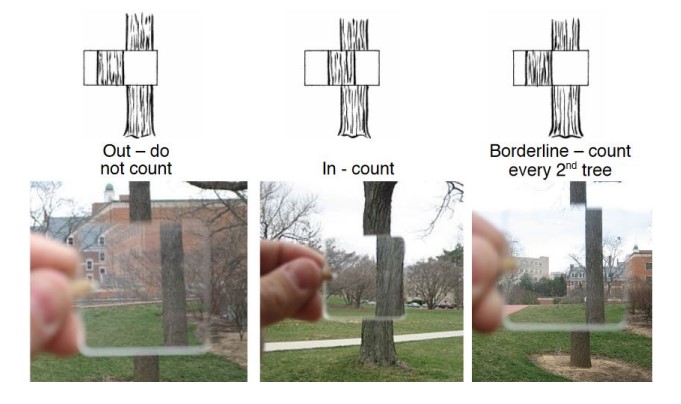
Angle count sampling involves a simple sweep of the forest from a fixed sampling point using a relascope, dendrometer sight, angle gauge, or glass wedge prism.
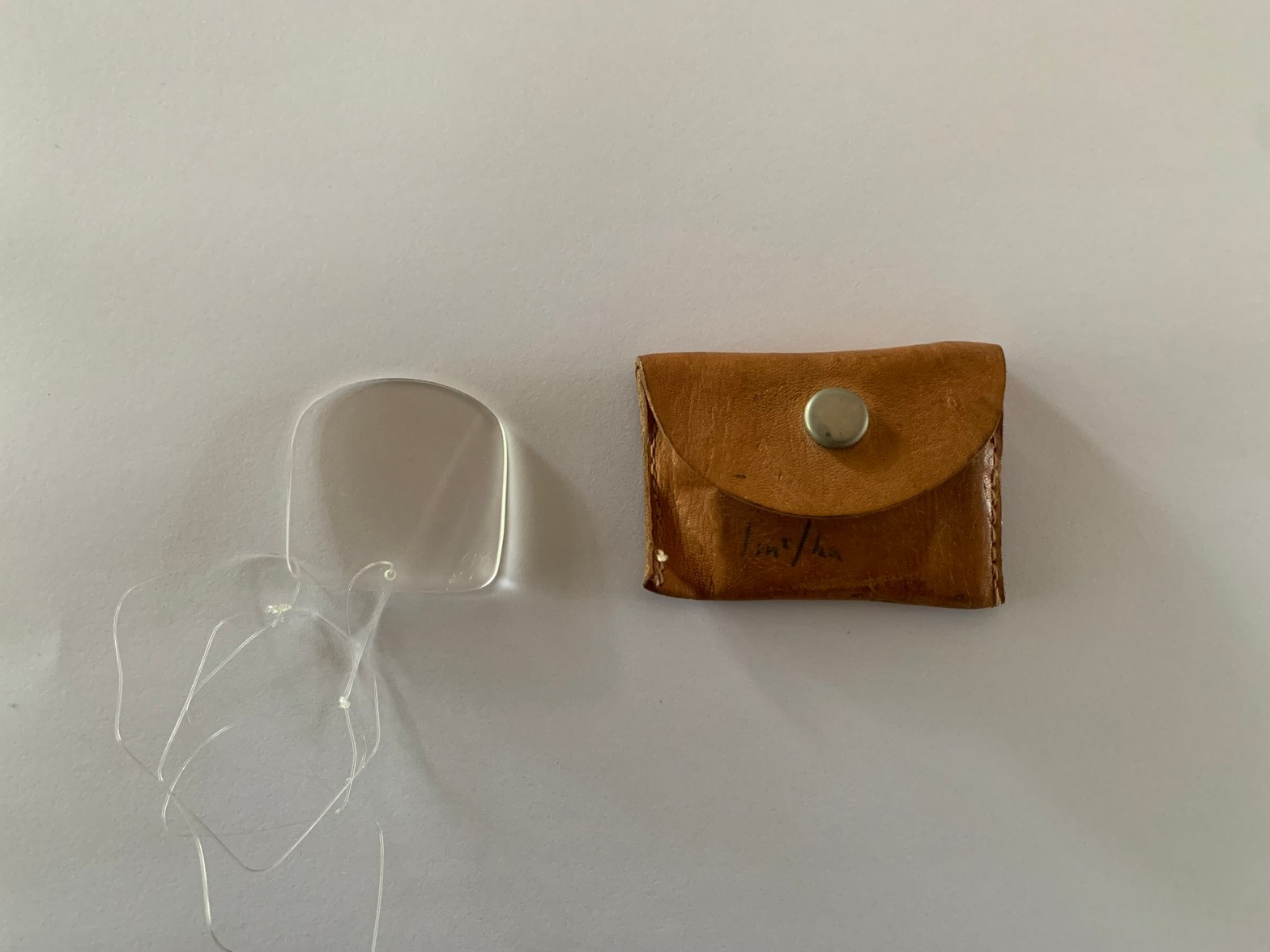
A glass wedge prism has a shallow angle (usually less than 3 degrees) which causes light to refract. Depending on tree size and how close you are, the vertical edge of the tree at breast height can appear separated. Standing in one spot, a sweep is made with the prism held at arm’s length, and trees are counted as either “in” or “out”. The number of trees is multiplied by conversion factor of prism (1 m2/ha in my case) to estimate basal area. It’s very quick and effective.
Basal area is commonly used during thinning operations to reduce the number of smaller or defective stems and concentrate growth on the larger and straighter trees.
A large area of 1950s mixed species regrowth (mostly silvertop and messmate) in the Boola forest, north of Traralgon, was mechanically thinned during the 1980s and ‘90s.
For the older regrowth stands it was usual to retain about 20-25 m2/ha, or at least 50% of the initial Basal Area. The thinned stems were sold to APM for pulpwood.
Main Photo: My glass basal area prism is 1 m2/ha.

 Victoria’s Forests & Bushfire Heritage