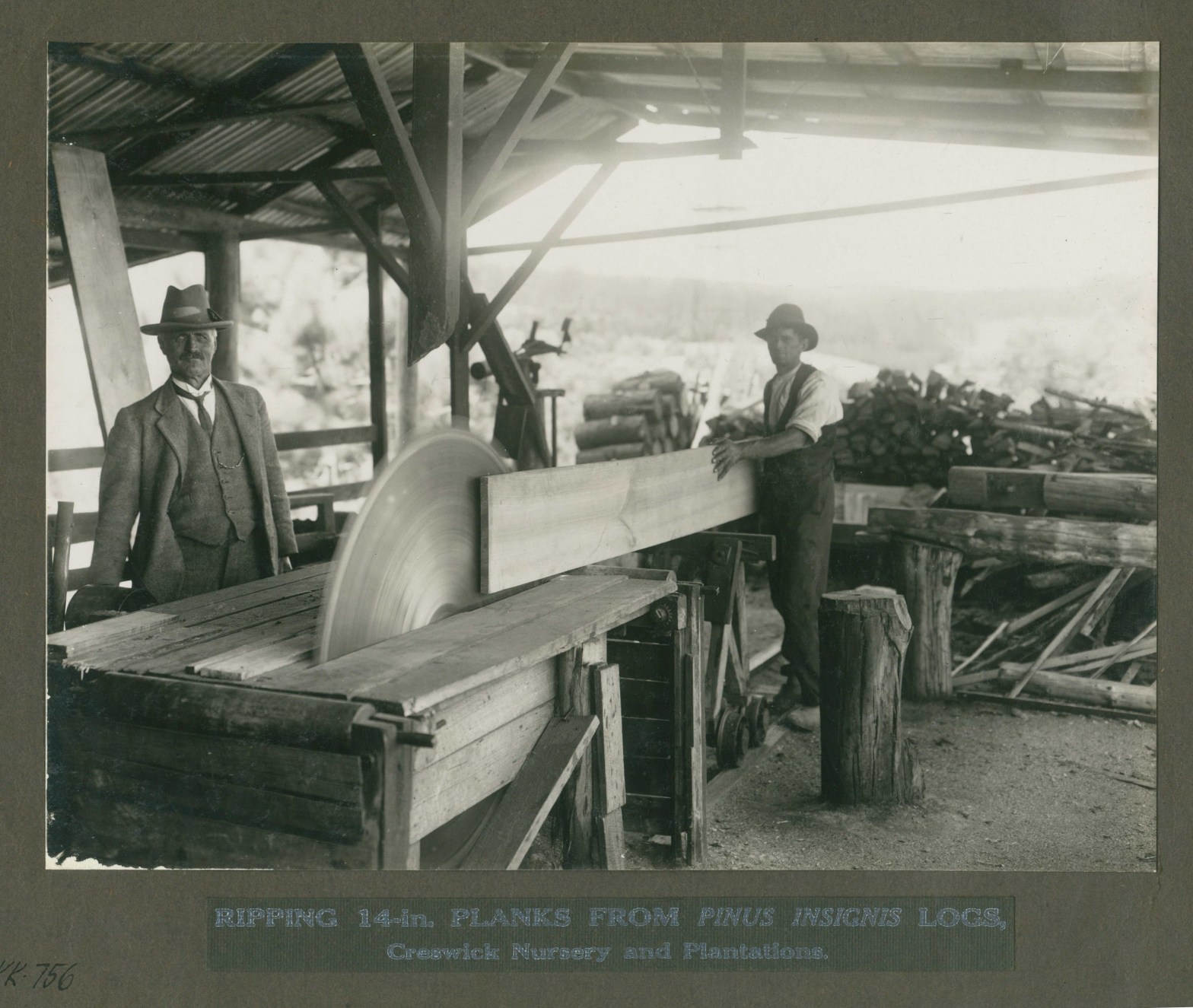
There are very few native softwoods in Victoria, and those that do exist, like white cypress pine (Callitris glaucophylla), grow too slowly to be suitable for large scale commercial plantations.
From its earliest days in the 1830s, Victoria imported large quantities of softwoods, mostly from north America and Scandinavia. The need for cheaper and more reliable local sources for internal work, furniture and joinery was apparent.
Early foresters quickly discovered that the physical properties of native forest hardwoods were unsuitable for some applications and plantation-grown softwoods offered the chance to replace expensive imports of Baltic Pine, Oregon and other timbers with domestic supplies.
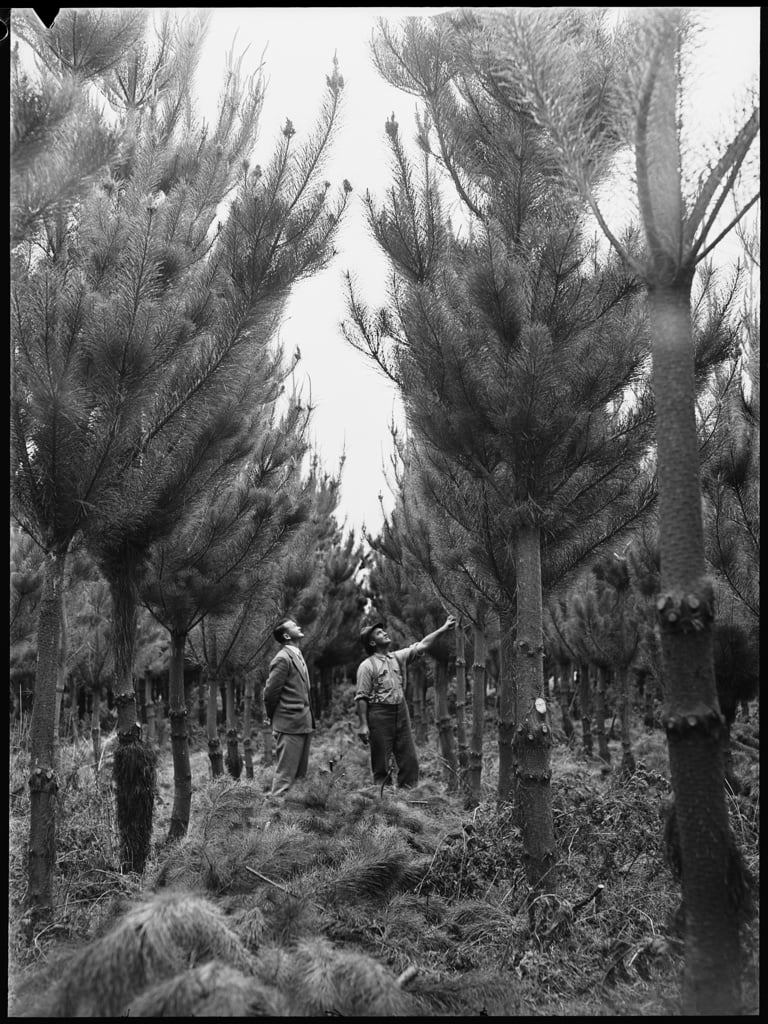
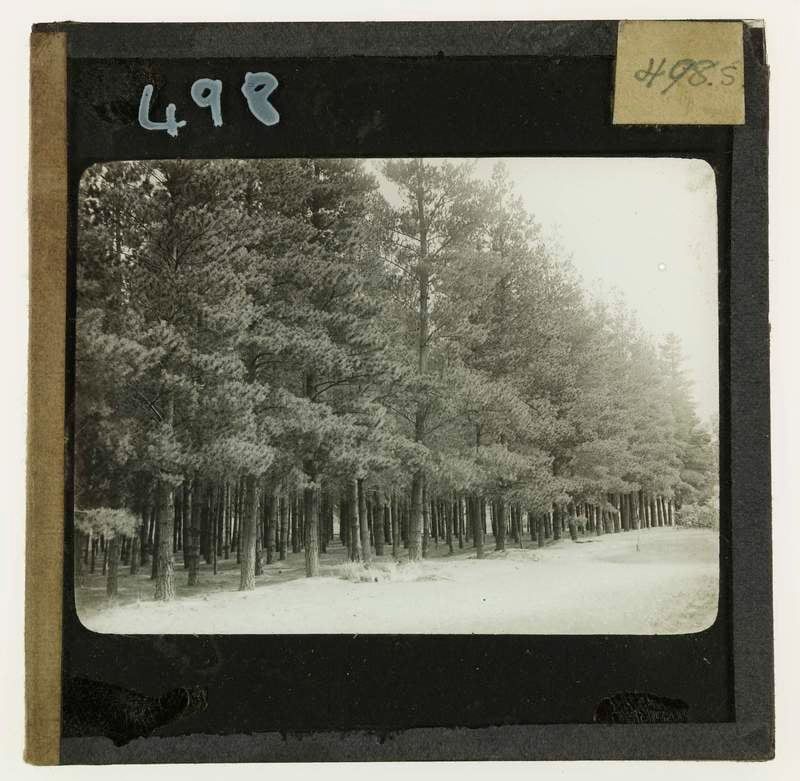
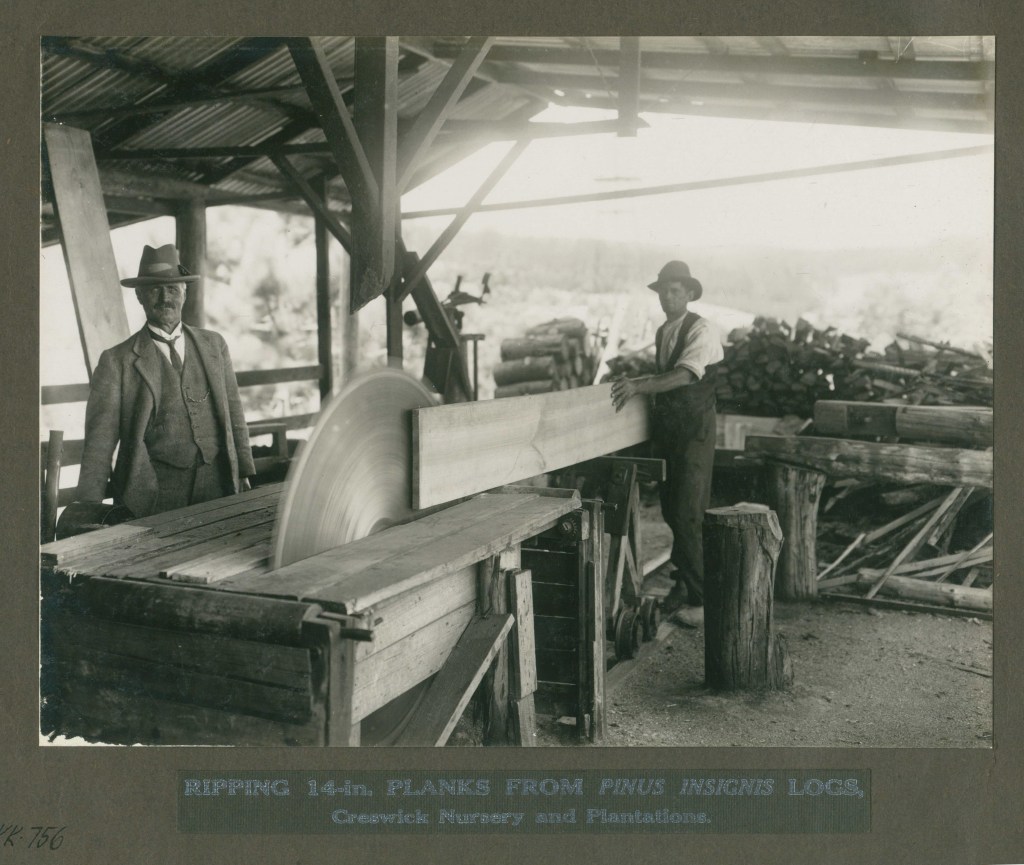
Pinus insignis (now called Pinus radiata), which is native to the central coast of California and Mexico, was first planted in gardens and windbreaks at Doncaster during the 1860s and grew well. It was sufficiently promising for commercial plantings to begin from 1887.
Initially, the planting goals were simply to rehabilitate land cleared during the gold rush, provide some timber and avoid the costs and unreliability of imported timber, generate some revenue and create jobs in local sawmills.
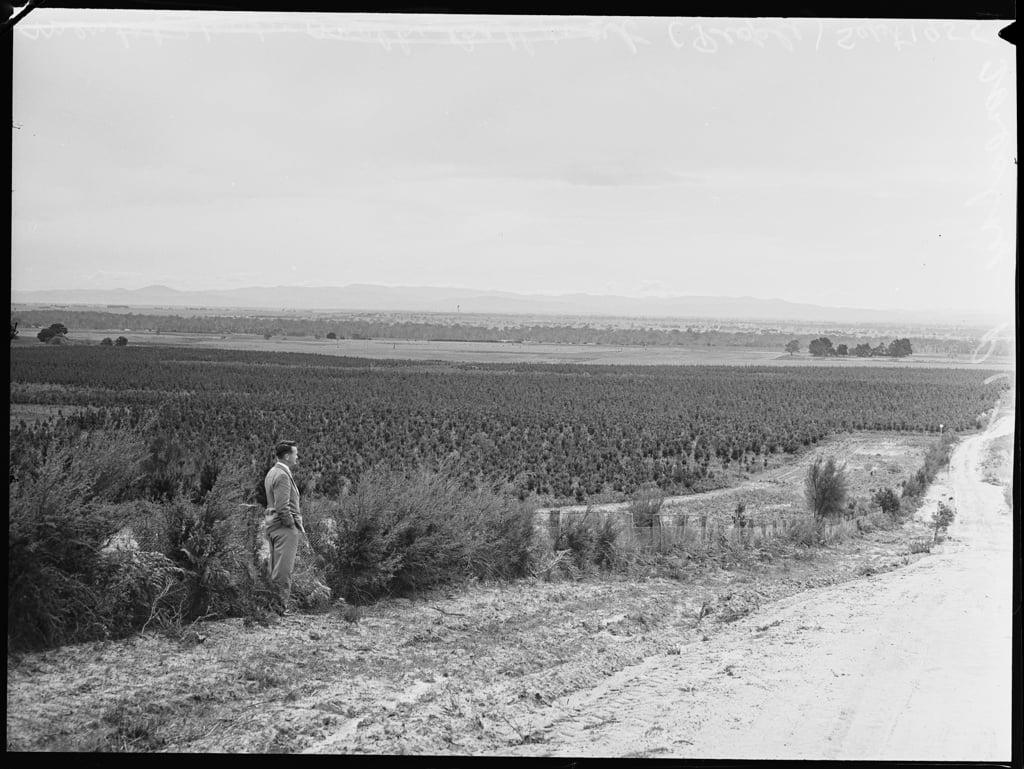
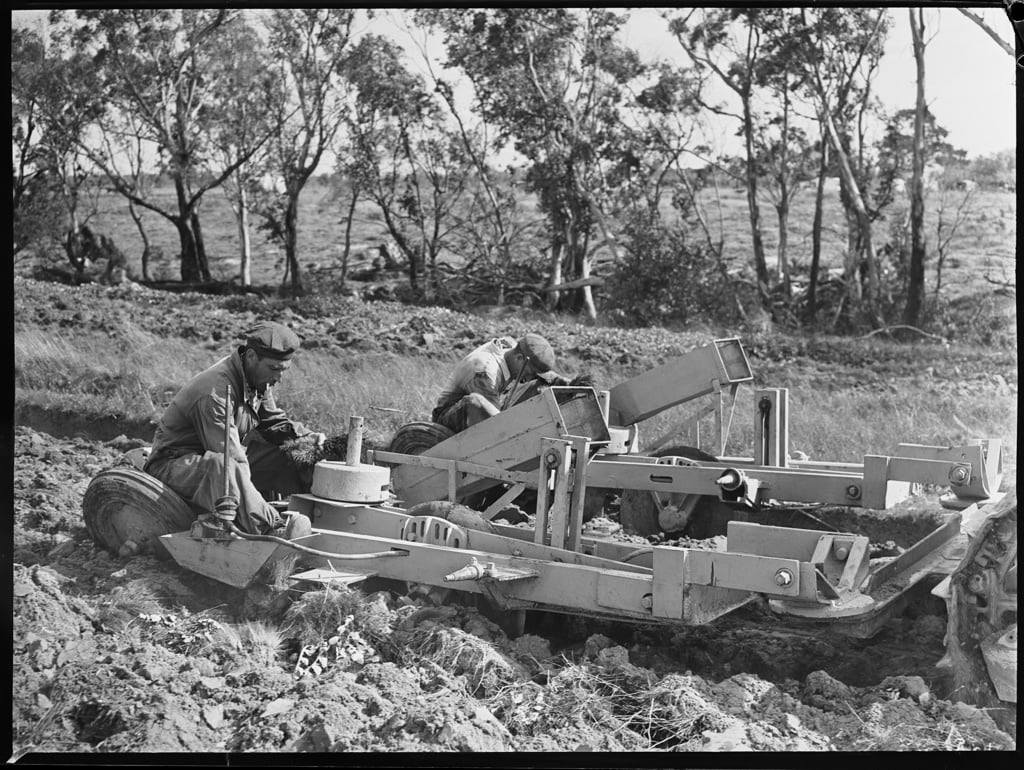
Experimental pine plantations were established under the stewardship of John Johnstone, the Victorian Superintendent of Plantations (and often overlooked founder of the forestry school at Creswick). These were at Frankston and Harcourt (1909), Wilsons Promontory (1910), Bright (1916), Port Campbell/Waarre (1919), Anglesea (1923) and Mount Difficult (1925). The largest plot was some 2,500 acres associated with the new McLeod Prison farm on French Island (1911).
However, nearly all these plantings failed due to poor soil and site conditions, but valuable silvicultural lessons were learned. The earlier success of radiata pine had partly given rise to the fallacy that it could grow anywhere.
Planting activity once picked up again in the 1930s with unemployment relief schemes during the Great Depression.
The Forests Commission began the Strzelecki reforestation program in the 1930s with planting of both softwoods and hardwoods on abandoned farmland of the “Heartbreak Hills”.
APM Forests (APMF) was formed in 1951 with the primary aim of supplying pulpwood to the Maryvale Mill in the LaTrobe Valley through the establishment of plantations and co-ordination of harvesting and transport. The company also invested heavily in plantations in the Strzelecki’s under the stewardship of Norwegian forester Bjarn Dahl.
In 1949, the Commonwealth Forestry and Timber Bureau proposed a national planting program to make Australia more self-reliant in timber after the shortages experienced during the second world war.
But the big leap for Victoria came in 1961, when the Chairman of the Forests Commission, Alf Lawrence, attended the World Forestry Conference in São Paulo Brazil, and upon his return took a bold decision to commit to a massive plantation expansion program which initiated nearly four decades of plantation establishment.
The Commission decision created a new wave of momentum and private investment optimism. The plantation area eventually reached a threshold where manufacturers could confidently establish major processing plants.
In 1964, the newly formed Australian Forestry Council (AFC) set a national estate target of 1.2 million ha by lifting the average annual planting rate from 16,000 ha to 28,000 ha and maintaining that level until 2000.
The Commonwealth agreed to provide loan funds to the States to plant more trees and Victoria took up the challenge by establishing and maintaining its plantations at nearly half the average cost of the other states.
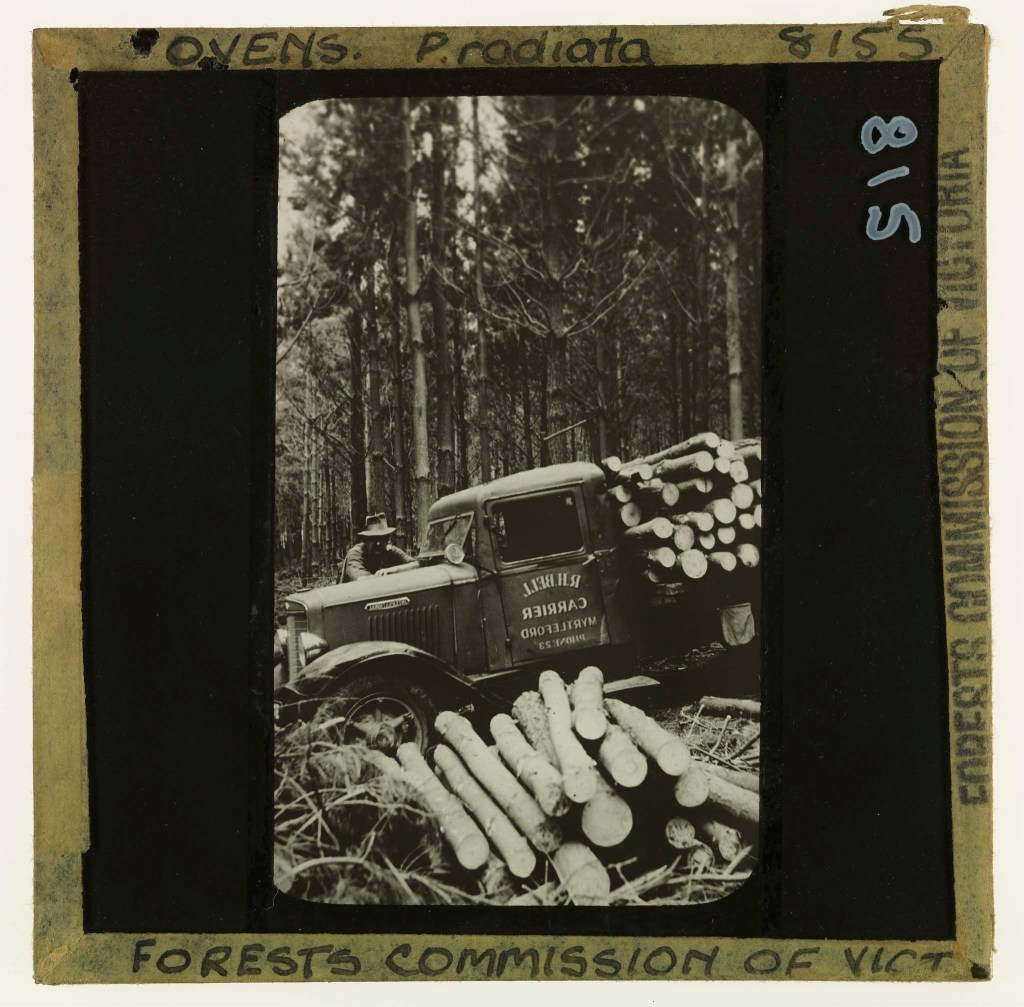
Over time the Commission identified eight major plantation zones at Benalla/Mansfield, Central, Ovens, Upper Murray, Latrobe, Portland/Rennick, Ballarat and the Otways.
Planting in Victoria peaked in 1969 with a record 5,183 ha.
By the end of 1982, when the amalgamated Department of Conservation, Forests and Lands (CFL) was formed, the Forests Commission had established 87,000 hectares of softwood plantations, a five-fold increase since 1940.
And as the government and private plantation base progressively expanded and matured, agreements were reached with private mills such as Bowater-Scott (now Carter Holt Harvey) at Myrtleford in 1972, and the Australian Newsprint Mills at Albury in 1980.
But attitudes towards pine plantations began to change in the 1970s with growing disquiet from environment and community groups about the social impacts of planting. These included changes to the profile of rural communities and farmland leading to the closure of small towns and schools, also concerns about fire protection, clearing of native forests and conversion to pines, together with the use of chemical sprays.
The Victorian Timber Industry Strategy (TIS) in 1986 set new government policies for the industry and management of public forests and plantations.
In 1987, the State Government introduced a policy to stop clearing of native forest for softwood plantations.
The State Labor Government started to explore options to sell the plantation assets in about 1990 but there were a number of complex legal, financial and practical impediments to overcome first. The Premier, Joan Kirner, confirmed in July 1992 that the State’s plantations would be corporatised and sold, with the entire estate vested into a newly formed state-owned enterprise known as the Victorian Plantations Corporation (VPC). The land was not sold.
A year later in 1 July 1993, under a new Kennett Liberal Government, the VPC took full legal control of 106,250 ha of softwood plantations. There were also 7,180 ha of hardwood plantations, which were mostly in the Strzelecki Ranges.
Later in 1998, the VPC was sold to an American and Australian superannuation company Hancock Victorian Plantations (HVP) for $550 million.
In about 2000, HVP acquired the plantation assets formerly owned by Australian Paper Manufacturers Forests (APMF) in Gippsland to become one of Australia’s largest softwood companies supplying over 3 million tonnes of wood annually to local manufacturing industries
The Green Triangle spans the border area between South Australia and western Victoria. Major private growers include Forestry-SA, Auspine, HVP, Associated Kiln Driers (AKD), Timbercorp and ITC with timber processing by Kimberly Clark, Carter Holt Harvey and Auspine.
The green triangle region grows around 160,000 ha of mature softwood plus another 110,000 ha of short-rotation hardwood plantations which were mostly established from the mid-1990s.
Victoria now has 382,600 hectares of privately owned and managed plantations, making up nearly a quarter of the national total.
And Victoria produces around 25% of Australia’s plantation grown wood, while the industry generates an average of $500 million in value per year.
In addition to local processing, about 5.3 million m³ of pulpwood (woodchips) are exported through Geelong and Portland each year.
With native forest timber harvesting set to end in Victoria in 2024, it’s fortunate that the visionary planting schemes by the Forests Commission, which then encouraged others, has left a large and thriving plantation industry.
Short rotation softwoods will never fully replace the beautiful slow-grown hardwood timbers that we all love, but thankfully the plantation legacy will meet some of our future timber needs.

https://drive.google.com/file/d/1DlUzyWyt7Jgf6tYNQONQy3ue12_EHW5a/view

 Victoria’s Forests & Bushfire Heritage
Hi Peter,
Great article as always.
I remember when my Dad was the forester for the Dandenong district and in the early 60s he suddenly had to deal with the Sirex wasp infestations in pine trees – especially down the Mornington Peninsula and around the Berwick and Silvan areas.
Many farmers in the region had planted Pinus Radiata trees as windbreaks and many of these trees were now infested with the Sirex wasp.
The process then was to identify the infected trees, cut them down and burn them – usually in situ. Some of these trees were huge and would take days to be burnt.
The Commission had to expand itsâ workforce at the Kallista office and supply a number of extra fire tankers for the crews to use. These tankers were mainly the WW2 era Chev and Ford CMP trucks and were surplus to the Commissionâs needs as these trucks were being replaced with the new Bedford 4WD tankers. Some of these trucks were not in a good condition but needs must!!
Kind regards,
Geoff
Geoffrey H Westcott CPA
43 Menzies Close
Frankston South Vic 3199
Office: (03) 9787 5510
Mob: 0419 386 766
Email: geoff@westcottaccounting.com.au geoff@westcottaccounting.com.au
Web: westcottaccounting.com.au
ABN: 53 076 716 934
Geoffrey H Westcott is a CPA Practice.
Liability limited by a scheme approved under Professional Standards Legislation.
This email is for its intended recipient(s) only. If this email has been sent to you in error, or contains privileged or confidential information, or the contact details of other persons, then you must not copy or distribute this information and I would like you to delete the email and notify me.
Whilst I take every endeavour to restrict viruses, Trojan horses and the like, liability is expressly excluded in the event of them accompanying this email or any attachment to it.
LikeLiked by 1 person