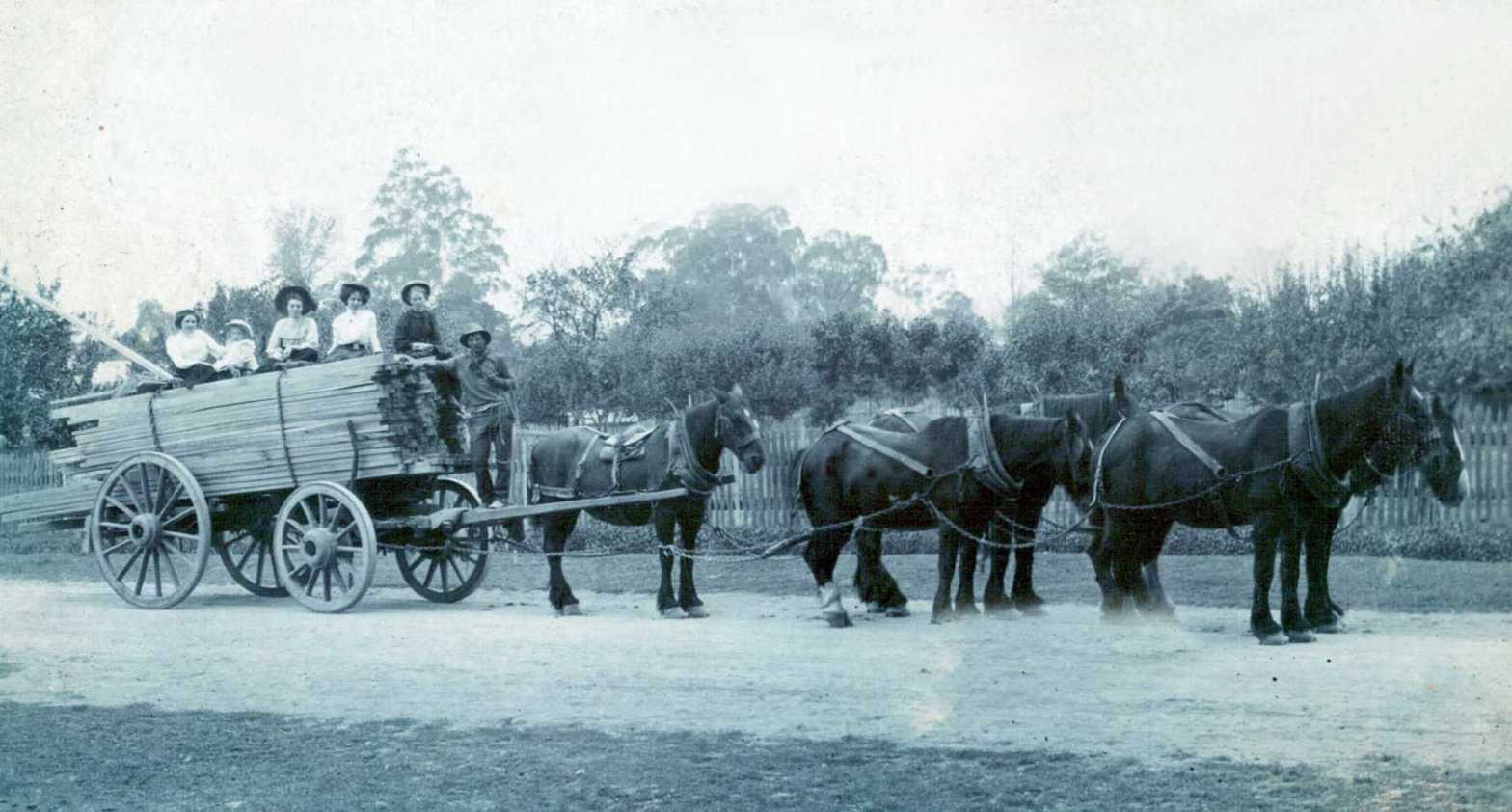
The arrival of the Victorian Railways narrow gauge train (now the iconic Puffing Billy) into Gembrook in about 1900 signalled the rapid expansion of sawmilling in the district.
Sawmills had operated at Gembrook from the 1880s, but their produce was transported by primitive tramways to places like Nar Nar Goon in the south. A new Victorian Railway with direct access to timber yards in Melbourne was a major turning point.
While not on the scale of the harvesting of the mountain ash forests at Noojee and Powelltown, at least sixty small sawmills worked the drier mixed species bush, and for some time the timber industry was the largest single employer in the Gembrook area.
By industry standards the individual mills were not large producers of sawn timber but there were many of them operating in the forest.
The mills ranged in size from small itinerant two-man spot benches to larger more permanent mills operated by well-known local identities like the Mortimer, Russell, Ure, Dyer and Williams families.
Together these mills produced a huge volume of sawn timber for a rapidly growing metropolitan Melbourne, but also fruit cases for the local orchards.
A complex network of tramways developed through the private land and adjoining State forests. These bush railways were built with ingenuity and resourcefulness by men with little or no formal engineering training but plenty of courage and years of experience.
But like most of Victoria’s timber industry, steam and rails were progressively replaced by diesel and roads in the post war area. Then in 1953, a landslide blocked the track and the line to Gembrook closed.
The production of sawn timber from Gembrook peaked in the 1920s and 1930s, with another spike in the 1950s, but then declined steadily over time, and by the mid-1980s only a few local hardwood sawmills remained. The reopening of the post 1939 ash timber resources in the Central Highlands had a big impact on the competitiveness of the smaller under capitalised Gembrook mills.
Today, much of the land around Gembrook is dedicated to farming. The State forests have been redesignated as national park and timber harvesting has ceased. But there is still evidence of these fascinating old tram lines and sawmills if you know where to look.
Ref: Mike McCarthy (1987). Bellbrakes, bullocks and bushmen. LRRSA.
Photo: My grandmother, Annie May Evans, is one of those ladies with the funny bonnets sitting on top of a load of sawn timber at Gembrook. C 1905.
 Victoria’s Forests & Bushfire Heritage