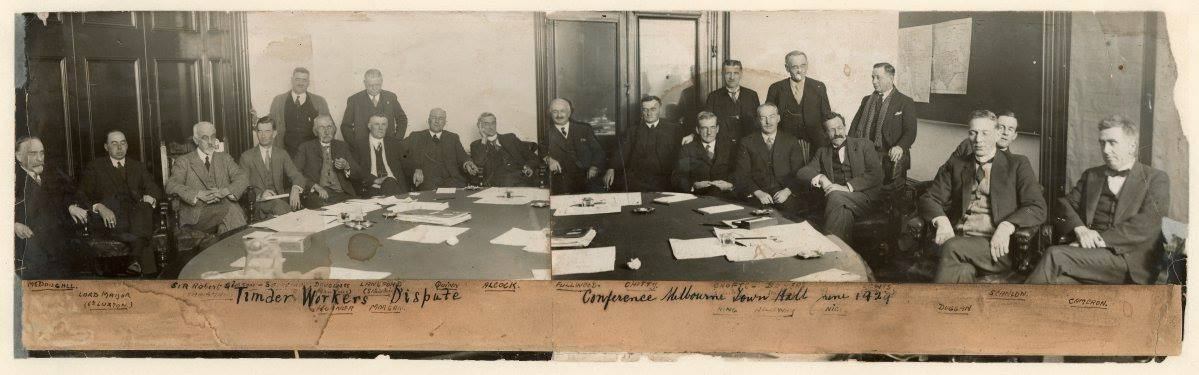
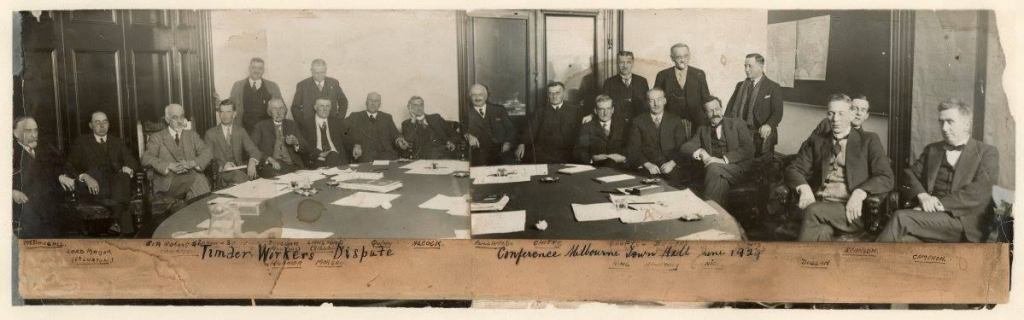
The 1929 timber workers strike was the first in Australia after the onset of the Great Depression.
The strike lasted nearly six months and affected all sections of the timber industry including the Forests Commission Victoria (FCV) which supplied logs from State forest. The Commission also operated its own sawmill at Nayook, near Noojee, as well as a major timber seasoning plant at Newport.
The Commission estimated the loss in production of sawn timber during the strike was £500,000, with the loss of direct revenue of £27,000.
The immediate cause of the dispute was a wages award made on 23 December 1928 by Judge Lionel Lukin from the Commonwealth Arbitration Court.
His decision reduced wages by 3 shillings per week and increased hours for 20,000 timber workers from 44 to 48 hours per week.
The decision also affected the ratio of juveniles to adults in the workforce which could lead to a major loss of adult jobs.
At the time, timber workers had a more generous pay deal compared to other sectors because of an earlier decision of the Arbitration Court in 1920.
Trouble had been brewing for some time. The Timber Workers Union was very militant under the leadership of future Labor Prime Minister, and ex Creswick lad, John Curtin.
After the 1925 election, the Nationalist Party Prime Minister Stanley Bruce seemed obsessed with industrial relations. He amended the Crimes Act in 1926 to “deal with industrial extremists”.
Bruce became emboldened after the 1928 election which he won on a law-and-order reform platform, mainly as it applied to unions. Timber workers, waterside workers and miners were his obvious targets.
It’s worth noting that the timber workers had more political clout in the 1920s because the Australian economy depended heavily on timber, with almost everything packed in wood such as fruit cases and butter boxes.
The urban nature of timber mills in 1929 also meant that industrial action was concentrated around the working-class areas of the affected cities such as Glebe in Sydney.
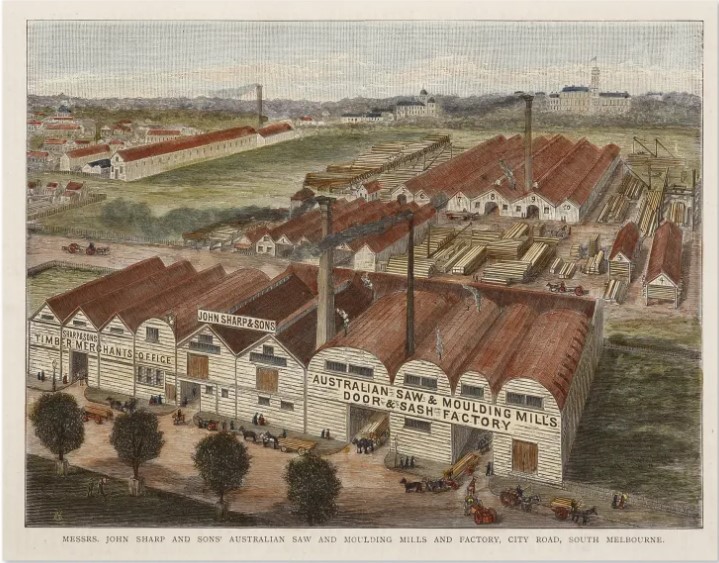
In Melbourne, the dispute centred in the industrial areas south of the Yarra where some major timber mills and wholesalers were located. The biggest was John Sharp and Sons at 169 City Road, South Melbourne. Millers was another large timber importer on Maffra Street while Wrights was in Sturt Street, whereas Fulwood’s was right in the middle of the City on the corner of Lonsdale and Spencer Street.
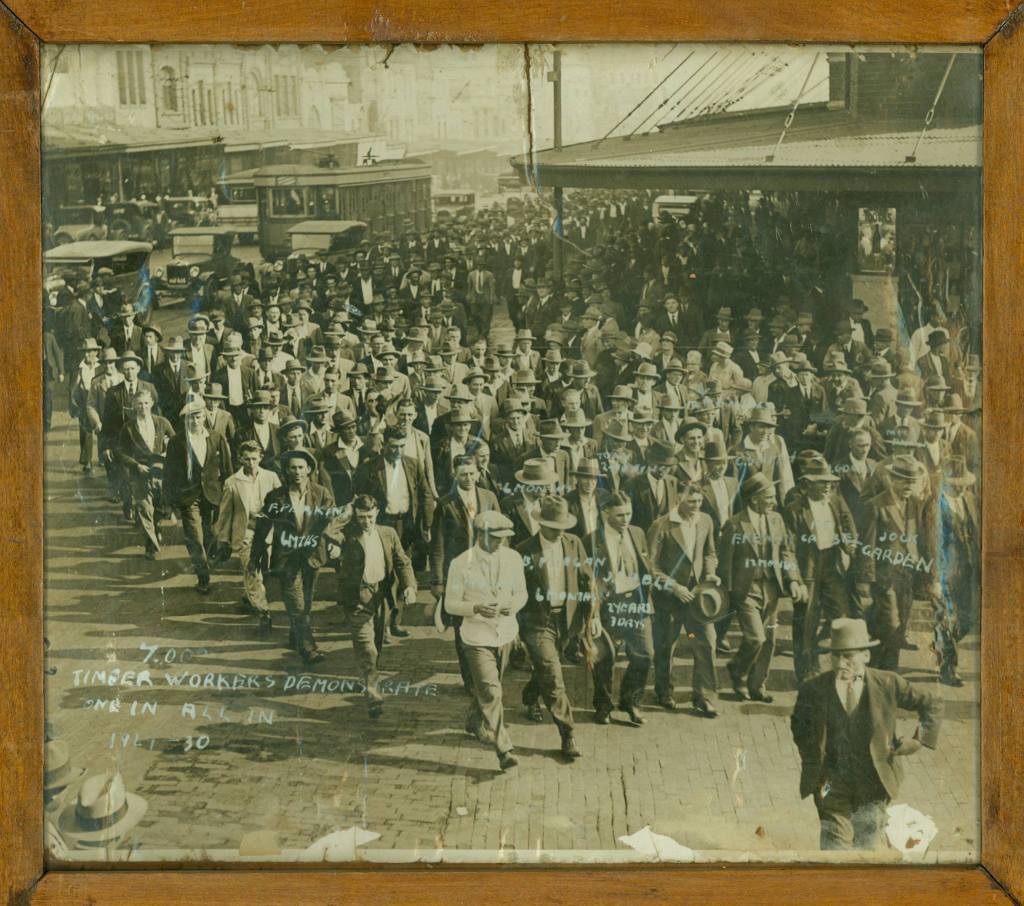
The timber workers held mass meetings on 3 January 1929 in Melbourne, Sydney, and Adelaide and refused to work the four hours extra stipulated by the Lukin award. The Federal Government took legal action against the Union which was fined £1000.
A secret ballot, which was largely boycotted by the workers, was held with an overwhelming number of those responding voting no to the new conditions. This was the first attempt to enforce a secret ballot in an Australian industrial dispute.
As the dispute dragged on things got a bit nasty. Near Powelltown one group of disgruntled strikers wanted to remove sections of the train tracks to stop “black” workers from arriving the township, but fortunately cooler heads prevailed, so instead they put grease the steel rails on an uphill stretch to the stop train getting through. The grease was quickly removed but the action caused considerable division amongst the townsfolk for some time to come.
Those that refused to work at Powelltown were threatened with eviction from company houses, but with the onset of cold weather this could have become a serious matter, and thankfully nothing came of it.
But striking families in the bush were far from the public eye and many left to find other work.
The strike dragged on and union support funds began to dry up, while some sawmills kept operating with scab labour. It was the middle of the great depression and people would do almost anything to earn a living.
It eventually became apparent that the workers could not hope to win, and by late June 1929, the strike had all but collapsed and most men chose to return to work.
At the end of July, seven union leaders were charged with “unlawful conspiracy by violence and threats of violence”, but a jury subsequently acquitted them.
Stanley Bruce lost the federal election in October 1929, in part, because of his Government’s approach to industrial relations.
 Victoria’s Forests & Bushfire Heritage