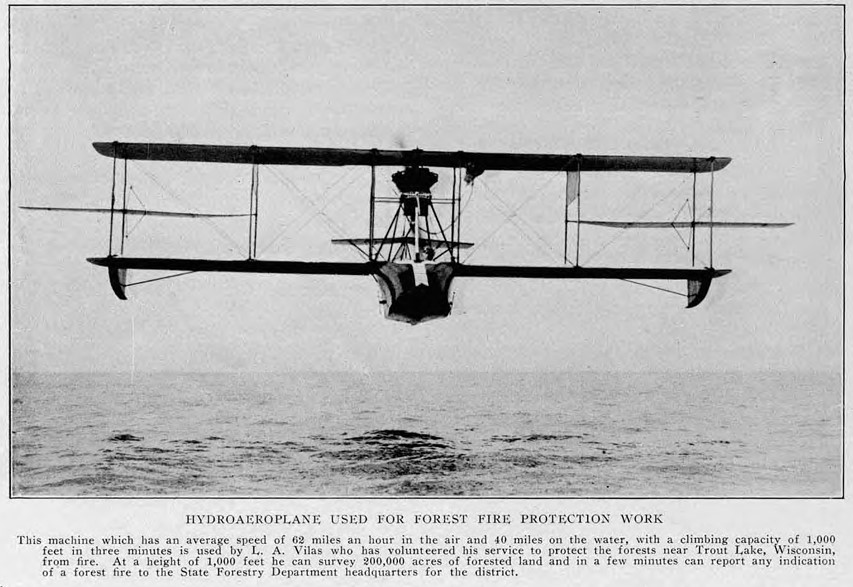
On 29 June 1915, 108 years ago today, what is believed to be the world’s first forest patrol flight was made at Trout Lake in Wisconsin.
Aviation pioneer and wealthy Chicago sportsman Logan “Jack” Vilas made the initial flight to demonstrate the viability of using aircraft in fire prevention.
He took Chief Forester, Edward Griffith, for a ride in his new Curtiss Flying Boat to demonstrate how easy it was to spot forest fires from the air.
Impressed, Griffith had the Wisconsin Conservation Commission appoint Vilas as a flying fire warden. Vilas flew almost daily in July and August from the forestry headquarters at Trout Lake in Boulder Junction.
The use of aerial detection to spot and report forest fires—dubbed the “Wisconsin Plan”—soon became a vital tool in fighting wildfires in many forested countries.
The U.S. Forest Service joined with the Army Air Service in 1919 to introduce aerial fire patrols over national forests.
Rumour has it that the planes were equipped with a telescope and machine gun as a deterrent to arson—the number of fires on the Cleveland National Forest decreased for a while.
But reviews by foresters were mixed. Not as many fires were first spotted by the air patrols as hoped, and the lack of wireless radios for communication between pilot and ground crew slowed the fire reporting process down significantly.
In 1925, Secretary of War, John Weeks, ended the program, telling the Forest Service it was time to turn patrols over to commercial operations. But having already purchased some planes the Forest Service continued their own patrols for two more years.
In Australia, discussion took place between the Forests Commission Victoria (FCV) and the Air Board as early as 1926, and then over a period of years prior to 1929-30, with the view to commencing regular fire patrols using RAAF aircraft but a lack of safe landing areas and radio communications proved the main obstacle.
Eventually, the first fire spotting aircraft in Australia was deployed on 18 February 1930 when a RAAF Westland Wapiti from No.1 Squadron operating out of Point Cook near Melbourne flew over the nearby Dandenong Ranges.
So break out your silk scarves and goggles to celebrate those daring young men in their flying machines because the rest is history….
American Forestry magazine – September 1915 issue.
https://foresthistory.org/wp-content/uploads/2018/07/AviatorDetectFires.pdf
https://foresthistory.org/envira/fire-suppression-aircraft/


 Victoria’s Forests & Bushfire Heritage