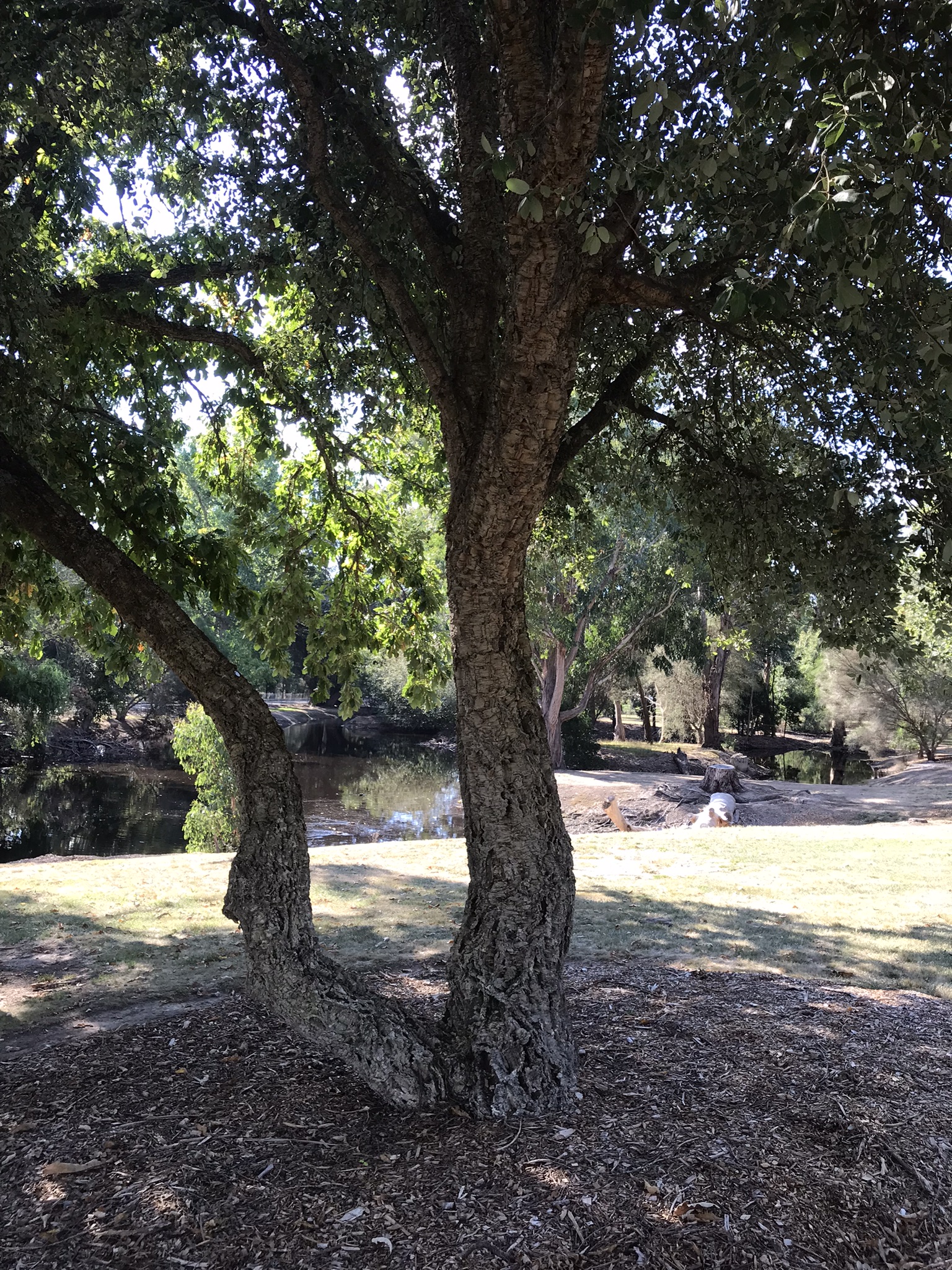
Cork Oak (Quercus suber) is a medium sized evergreen tree which was planted in Australia as a specimen in many parks and gardens from the mid-19th century.
The oldest tree is said to be in the Royal Tasmanian Botanic Gardens, which was planted 1857, and the largest at Tenterfield, in northern NSW, was planted in 1861.
Cork has been used since ancient times as bottle stoppers, footwear, flooring, insulation, and floats for fishing nets. Most of the global supply traditionally came from Spain, Portugal, and Algeria.
The thick bark is first harvested by hand when trees are about 25 years old, and thereafter at 9-to-12-year intervals.
This specimen was planted in the grounds of the forestry school at Creswick.
A small plantation of cork oak was planted in State forest at Mt Macedon in 1887. Cork from this plantation was harvested in 1930 by the well-known local processing firm of Vogts. This plantation was later destroyed in the 1983 Ash Wednesday bushfires.
Australia’s largest and most successful plantation of cork oaks is at the National Arboretum near Canberra where 9 ha was established in 1917 and 1920 with acorns initially sourced from the Melbourne’s Royal Botanic Gardens.
During the 1920s, Vogts, lobbied the Victorian Government and the Forests Commission, urging planting of commercial cork oak plantations to support a local industry and reduce imports.
Somewhat reluctantly, in 1929 the Commission agreed to establish cork oak trials at Beechworth, as well as two acres at the southwest corner of the Mt Beckworth State forest. The acorns came from the trees at Mt Macedon.
There were further intermittent calls for commercial plantations during the 1940s and 1950s.
However, to support and nurture a fledgling cork oak industry needed to supply 3000 tons annually, particularly with a long lead time of 25 years, required 24,000 acres of government land and a substantial cash subsidy.
Despite the pressure, cork oak plantations remained a low priority for the Forests Commission, which remained focused on establishing the State’s pine plantations to meet future timber needs.
After renewed political lobbying in the early 1960s, further cork oak sites, of 12 acres each, were chosen on granitic outwash soils at Castlemaine, Yarrawonga, Benalla, Beechworth and Creswick Forest Districts, this time on the western side of Mt Beckworth. These acorns were sourced from Portugal.
Each of the plots were prepared, and in July 1965, 700 seedlings were planted on 20 feet by 20 feet spacing.
Because of problems with seedling quality these plantings were not a success, and by October 1965 high mortality was being reported.
Undeterred, more acorns were sourced, and seedlings raised during 1966 in the FCV nursery at Macedon ready for replanting in the winter of 1967.
In the end, all the Forests Commission’s cork oak plantations were abandoned in the 1970s and the expected industry failed to develop.
 Victoria’s Forests & Bushfire Heritage